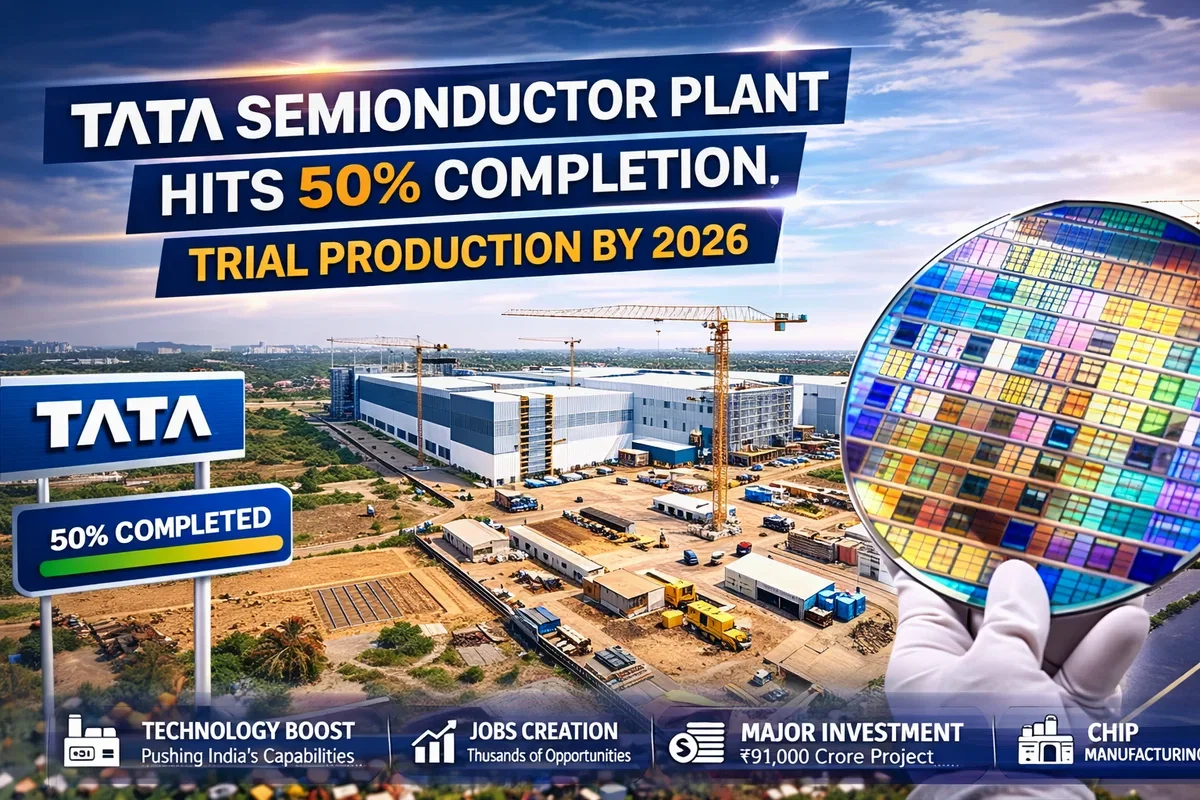

The Tata semiconductor plant in Dholera has reached 50% construction completion, marking a significant milestone in India’s chip manufacturing journey.
As part of the India Semiconductor Mission, the ₹910 billion ($9.78 billion) Tata-PSMC chip manufacturing facility in Dholera, Gujarat, represents the country’s largest semiconductor fabrication initiative. Developed by Tata Electronics in partnership with PSMC, the project highlights strong execution progress and brings India closer to establishing domestic chip manufacturing capabilities.
With trial production expected by late 2026, the project is now transitioning from infrastructure development to advanced technical setup.
Tata Semiconductor Plant in Dholera Achieves 50% Construction Milestone
Reaching 50% completion in a semiconductor fabrication project is not just a symbolic achievement; it reflects substantial progress across multiple complex layers of development. This milestone in the Tata semiconductor plant construction marks significant progress in one of India’s most complex industrial projects.
Key Infrastructure Completed at 50% Stage
- Highly specialized infrastructure
- Ultra-clean manufacturing environments
- Precision engineering at nanoscales
At this stage, core structural development, foundational systems, and initial facility frameworks are largely in place. The project now transitions toward more advanced phases, including equipment installation and cleanroom development.
The pace of construction so far suggests that the Tata Electronics semiconductor project is broadly on track with its planned timeline, as it indicates that foundational infrastructure is complete and the project is moving into advanced phases like cleanroom setup and equipment installation.
What Will the Tata-PSMC Semiconductor Plant in Dholera Produce?
The plant will produce mature-node semiconductors used in automobiles, electronics, telecom, and industrial systems. Dholera facility is being developed as a semiconductor fabrication unit (fab), designed to manufacture chips used in essential industries.
Key Industries Using These Semiconductors:
- Automobiles and electric vehicles
- Consumer electronics
- Telecommunications equipment
- Industrial systems
These chips may not represent the most cutting-edge technology, but they are critical to global semiconductor supply chains and remain in consistently high demand. By focusing on this segment, the plant aligns its production strategy with immediate and practical market needs.
Tata Semiconductor Plant in Dholera Partnership Details: Tata Electronics and PSMC
The Tata-PSMC semiconductor project partnership combines Tata Electronics and Taiwan-based execution strength with PSMC’s manufacturing expertise.
Contribution of PSMC in Semiconductor Manufacturing
- Tata Group’s execution capability and local presence
- PSMC’s semiconductor manufacturing expertise
Such collaboration is essential in semiconductor fabrication, where technical know-how, process precision, and operational experience play a crucial role in determining success. The progress to 50% completion also reflects coordination between multiple stakeholders, including engineering teams, global suppliers, and project management units.
Why was Dholera Selected for the Tata Semiconductor Plant?
The Dholera Smart City development update highlights that the plant is located in the Dholera Special Investment Region (SIR), a planned industrial and smart city zone designed for large-scale infrastructure projects, with the semiconductor plant location strategically chosen to support large-scale, high-tech manufacturing.
Infrastructure Support in Dholera Region:
- Availability of large contiguous land
- Planned industrial infrastructure
- Strong state-level support
Infrastructure growth in Dholera, Gujarat is being driven by the region’s development to accommodate advanced manufacturing projects, with the semiconductor plant emerging as one of its flagship developments. As construction progresses, the site is expected to evolve into a high-value industrial hub centered around electronics and technology manufacturing.
Tata Semiconductor Plant in Dholera Timeline: Trial Production by 2026
With 50% of construction completed, the project now moves into its most technically demanding phases.
Key Phases Before Trial Production in 2026:
- Installation of semiconductor fabrication equipment
- Development of cleanroom facilities
- System integration and testing
Trial production is expected to begin by late 2026. This phase will involve initial manufacturing runs to test processes, calibrate equipment, and optimize output quality. Following successful trials, the plant will gradually scale toward commercial production. Each of these stages requires precision and timeliness, as India's first semiconductor fab construction in Dholera relies heavily on process stability and yield optimization.
Impact of Tata Semiconductor Plant in Dholera on India’s Semiconductor Industry
The 50% completion milestone demonstrates that the Tata-PSMC semiconductor project is progressing steadily through one of the most complex forms of industrial development.
Contribution to India’s Semiconductor Mission
- Execution capability at scale
- Alignment between project partners
- Movement into advanced stages of development
For stakeholders tracking India’s semiconductor journey, this milestone provides a concrete update on progress rather than projections.
Final Thoughts
Long-term investment opportunities in Dholera are becoming more evident as the Tata Electronics–Powerchip Semiconductor Manufacturing Corporation chip plant reaches 50% completion, marking a clear shift from planning to execution, and with trial production targeted for 2026, the project is entering a phase where timelines, technology integration, and operational readiness will define its success.
Residential plots in Dholera for investors are gaining attention as construction continues and the facility moves closer to becoming operational, with this milestone standing as a measurable indicator of progress in building semiconductor manufacturing capability, and the halfway mark confirming that one of India’s largest semiconductor projects is firmly underway, even as the next phase remains critical.