Dholera has become one of the most talked-about land investment destinations in India, and for good reason: it's a government-backed greenfield smart city with an operational expressway, an international airport nearing completion, and anchor industrial investments already breaking ground. That combination of infrastructure and early-stage pricing is exactly what draws investors in. However, investing in land in a fast-developing region also carries real risks: unclear titles, unapproved layouts, agricultural land marketed as "ready to build" and brokers who overlook important legal details.
To Buy a plot in Dholera isn't complicated, but it does require a structured process, one that treats legal and financial due diligence as the first step, not an afterthought. Working with a Real Estate Legal Consultant in Dholera can help you verify land titles, approvals, ownership records, and regulatory compliance before making any commitment. This guide walks you through that process, from understanding the region to registering your sale deed.
This guide is based on publicly available regulations from DICDL, DSIRDA, the Gujarat Revenue Department, GujRERA, FEMA, and standard real estate legal due diligence practices followed by property lawyers in Gujarat. While every property transaction is unique, the verification process described here reflects accepted industry practice.
A. What Is Dholera SIR? Everything You Should Know Before Buying a Plot
Dholera SIR is India's first planned greenfield smart city, developed under a government-approved master plan with defined Town Planning (TP) Schemes, zoning regulations, and Upcoming major infrastructure projects in Dholera. Before buying a plot, investors should understand how TP Schemes, land use, infrastructure, and legal approvals affect ownership rights, construction eligibility, and long-term investment value.
1. What Is Dholera SIR and Why Is It Important for Investors?
Dholera SIR is a government-planned smart city where land development follows approved town-planning schemes instead of unregulated expansion. Investors benefit from greater planning transparency, but every plot must still be independently verified before purchase.
The Dholera Special Investment Region (SIR) is India's first greenfield smart city, developed under a structured land-pooling and town-planning framework rather than organic, unplanned growth. It falls within the Delhi–Mumbai Industrial Corridor (DMIC) and is governed by Dholera Industrial City Development Limited (DICDL) along with the Dholera Special Investment Region Development Authority (DSIRDA), under the broader oversight of the Government of Gujarat.
This planned-city structure is precisely why Dholera behaves differently from typical land markets: development, pricing, and legal status all follow a defined scheme rather than ad hoc private dealings.
2. Which Infrastructure Projects Are Increasing Land Prices in Dholera?
Infrastructure is the primary driver of land appreciation in Dholera. Rather than buying solely based on marketing claims, evaluate how close a plot is to completed or actively progressing infrastructure projects.
Several large infrastructure projects are shaping investor interest in the region: the Ahmedabad-Dholera Expressway, now fully operational and cutting travel time significantly; the Dholera International Airport, which has progressed through its final development phases; and large industrial anchors, including a major semiconductor fabrication investment that has drawn ancillary businesses and workforce demand into the region.
Each of these projects directly influences infrastructure development and helps determine where legally ready-to-build plots are available and therefore where legal, ready-to-build plots are actually available.
3. What Are the Residential, Commercial, and Industrial Zones in Dholera?
A plot's zoning determines its legal use, resale demand, and future development potential. Always match the zoning classification with your intended investment objective before purchasing.
Dholera SIR land is zoned by use, and the zoning classification directly determines what you're legally allowed to build:
Residential zones, primarily concentrated in TP 1 and TP 2, are designed with planned utilities, open spaces, and social infrastructure.
Commercial zones, including Shop-Cum-Office (SCO) plots, are generally positioned near high-access corridors and the ABCD Building (Administrative and Business Centre for Dholera).
Industrial zones, often allocated directly by DICDL or the Gujarat Industrial Development Corporation (GIDC) to registered businesses, typically come under long-term lease structures with plug-and-play utilities.
Buying the wrong zoning classification for your intended use, for example, purchasing agricultural land expecting to build a house, is one of the most common and costly mistakes new investors make.
4. How the Government's Long-Term Development Plan Shapes Dholera
Low prices, proximity claims, and promotional promises should never replace legal verification. Independent due diligence remains the most reliable safeguard for investments.
Dholera SIR is positioned as a flagship project under India's broader industrial and urban development strategy, with government infrastructure spending prioritizing roads, power, water, and drainage ahead of large-scale private construction, an "infrastructure-first" approach that differs from how most Indian cities have historically grown.
5. Common Misconceptions About Investing in Dholera
A few misconceptions come up repeatedly: that any land "near Dholera" is part of the SIR (it often isn't); that a lower price always means a better deal (it frequently signals missing documentation or missing NA status); and that RERA registration alone guarantees legal safety (RERA covers project-level disclosure, not title verification, which buyers must still do independently).
B. How to Choose the Right Plot in Dholera Based on Your Investment Goals
The right plot depends on your investment objective. Buyers planning self-use should prioritize plots in infrastructure-ready TP Schemes, while long-term investors can evaluate emerging development zones with clear legal status. Budget, zoning, resale potential, and holding period should all be considered before making a purchase.
1. Should You Buy a Plot in Dholera for Self-Use or Investment?
Buyers planning to build a home or business in the future should prioritize plots inside fully serviced TP schemes (TP 1/TP 2) where construction permissions are realistically achievable in the near term. Pure investors with a longer horizon have more flexibility to consider emerging TP zones at a lower entry cost.
2. Short-Term Speculation or Long-Term Wealth Creation?
Most independent market analyses frame Dholera as a planned, infrastructure-led appreciation story rather than a short-term speculative flip opportunity. Investors expecting quick gains face more risk than those planning a 5–10-year holding period aligned with infrastructure completion milestones.
3. How Much Budget Do You Need to Buy a Plot in Dholera?
Land loans for plots are typically harder to secure than home loans, since banks and housing finance companies view undeveloped plots as higher risk and generally offer lower loan-to-value ratios and higher interest rates. Budget for the full acquisition cost, not just the plot price, including stamp duty, registration, legal fees, and any NA conversion charges if applicable.
4. Residential vs Commercial Plots in Dholera: Which Is Better?
Residential plots offer a lower entry cost and a wider buyer pool for eventual resale. Commercial and SCO plots cost more upfront but can offer stronger income potential through retail or office use, particularly near high-access corridors.
5. Exit Strategy and Resale Potential
Consider the resale potential right from the start. Plots with legally verified and approved Town Planning (TP) schemes, clear Non-Agricultural (NA) status, and complete documentation generally sell more easily and attract more buyers; furthermore, the resale process is simpler compared to disputed land or land awaiting approval.
Before purchasing, assess the holding period required to align with your investment goals, the documentation needed for resale, and the realistic timeframe for price appreciation to determine if the plot is the right choice for you.
C. How to Verify Land Ownership and Legal Documents Before Buying in Dholera
Before purchasing land in Dholera, verify the ownership title, 7/12 extract, Village Form 8A, mutation records, Encumbrance Certificate, and supporting legal documents. Independent legal due diligence helps confirm ownership, identify disputes or liabilities, and reduce the risk of future legal complications.
1. How to Check the 7/12 and Revenue Records
Revenue records should always match the seller's documents, survey number, and physical plot location before negotiations proceed.
The 7/12 extract (along with Village Form 8A in Gujarat) is the foundational revenue record showing the current recorded owner, land classification, and any recorded encumbrances or disputes. Always obtain these records directly rather than relying on a summary provided by the seller or broker, and cross-check the survey number against the plot being sold.
2. How to Verify a Clear Land Title in Dholera
A legally transferable title is essential for both ownership security and future resale. A clear, marketable title means the seller has undisputed, transferable ownership with no pending litigation or competing claims. Engaging an independent property lawyer to trace the ownership chain, ideally going back multiple transactions, is a standard and essential step before any land purchase in a developing region.
3. Checking for Loans, Liens, and Encumbrances
Hidden financial liabilities attached to land can transfer unexpected legal complications to buyers, making encumbrance verification indispensable. Request an Encumbrance Certificate to confirm the land carries no outstanding mortgage, loan, or legal claim. A property with an undisclosed lien can leave the buyer legally exposed even after payment, so this step should never be skipped, regardless of how trustworthy the seller appears.
4. How to Verify Mutation Entries and Ownership History
Consistent mutation records strengthen confidence that previous ownership transfers were completed correctly. Land mutation records confirm that ownership transfers have been properly updated in government revenue records after each historical sale. Gaps or inconsistencies in the mutation trail are red flags that warrant investigation before proceeding.
5. Why Legal Verification Should Never Be Skipped
Buyers who skip independent legal review are the ones most likely to face title discrepancies, missing documentation, or disputed ownership later. These problems are far more expensive to resolve after purchase than to catch beforehand.
D. Understanding TP Schemes, Zoning, and NA Status Before Buying Land
Zoning regulations and NA status determine how a plot can legally be used. TP Schemes, zoning, and Non-Agricultural (NA) status determine how a plot can legally be used and developed. Investors should confirm that the land falls within an approved TP Scheme, has the correct zoning classification, and holds valid NA approval before completing a transaction.
1. Agricultural vs NA Land in Dholera: Which Should You Buy?
Agricultural land must first be converted to Non-Agricultural (NA) status before residential or commercial construction is legally permitted. Agricultural land cannot legally be used for residential or commercial construction unless it has been formally converted to Non-Agricultural (NA) status by the competent revenue authority. Any NA order should clearly state the survey number, area, and the specific permitted use (residential, commercial, or industrial). A mismatch here can block construction plans entirely.
2. What Are TP Schemes in Dholera and Why Do They Matter?
Dholera SIR is organized into multiple Town Planning Schemes (TP Schemes), each representing a distinct development phase and geography. TP Scheme 1 and TP Scheme 2 are the most build-ready, sitting closest to the Activation Area, the expressway, and Completed Infrastructure Projects, while later-phase TP schemes are still being developed.
3. How to Check Government Acquisition and Reservation Zones
Some land within the wider Dholera region is reserved for government infrastructure, roads, or public use as part of the master plan. Always confirm a plot is not located within a reservation or acquisition zone, since this can affect both usability and long-term value regardless of how it's marketed.
4. FSI, Road Widths, and Development Regulations
Floor Space Index (FSI), setback requirements, and road-width regulations vary by TP scheme and zoning category under Dholera General Development Control Regulations (GDCR). These determine how much you can actually build, so confirm current FSI allowances for your specific plot before finalizing a purchase, especially for commercial or SCO plots.
5. How Zoning Affects Future Property Value
Zoning discipline is part of what protects long-term value in Dholera. Residential zones are deliberately separated from industrial areas, and commercial land is concentrated near planned access corridors, which is intended to prevent the property-value erosion that comes from incompatible neighboring land use.
E. How to Inspect a Plot Before Buying in Dholera
A physical site inspection helps verify that the plot matches its legal documents and advertised features. Buyers should inspect boundaries, road access, surrounding infrastructure, utilities, environmental conditions, and nearby developments before making any financial commitment.
1. What to Check During a Site Visit
Confirm the plot's boundaries match the layout map, verify that internal roads and utility connections are actually present (not just planned), and verify that the plot isn't encroached upon or being used by a third party.
2. Road Access, Utilities, and Connectivity Assessment
Validate direct road access to the plot; this affects both usability and future resale value. Also check the status of water, power, and drainage connections, since Dholera's phased infrastructure rollout means service levels can differ significantly even between nearby plots.
3. Does Distance from the Airport Affect Plot Value in Dholera?
Proximity to the Dholera International Airport and major industrial corridors is one of the strongest value drivers in the region, but "near the airport" claims should be verified by checking the actual distance and TP scheme boundaries rather than taken at face value from marketing material.
4. How to Check Flood Risk and Environmental Factors Before Buying
Check for environmental clearances and confirm the plot isn't located in a flood-prone or low-lying area, particularly important given Dholera's coastal-adjacent geography. This information should be available through DSIRDA's layout and environmental documentation.
5. Red Flags Investors Should Watch For
Watch for: plots marketed as "SIR-adjacent" without clear TP scheme confirmation, sellers unwilling to produce original documents, pricing significantly below comparable verified listings, and pressure to close quickly without time for independent legal review.
F. How to Verify Developers, Brokers, and Land Sellers in Dholera
Choosing a reliable seller is just as important as choosing the right plot. Verify the developer's credibility, review legal documents independently, and avoid transactions based solely on verbal commitments or promotional claims.
Always verify the credibility of the developer or seller before buying a plot. Review project approvals, ownership documents, RERA registration where applicable, business history, and customer references, and never rely solely on verbal assurances or promotional claims.
1. How to Identify Genuine Land Developers
Assess a developer's track record, years in operation, number of completed projects, and the quality and completeness of legal documentation provided to past buyers. A physical office presence in Ahmedabad or at the ABCD Building, along with verifiable past project delivery, further strengthens credibility.
Questions Every Buyer Must Ask a Seller.
Which TP scheme does this plot fall under, and is it approved? Is the NA order in place, and does it match the intended land use? Is the project RERA-registered, and can you provide the registration number for independent verification? Is the title clear, and can you provide the full ownership chain?
2. Warning Signs of Fraudulent Property Deals
Be cautious of unregistered brokers offering land "outside official channels," sellers who discourage independent legal review, layouts without a verifiable DSIRDA scheme reference, and any request to pay significant amounts before documentation has been reviewed.
3. Importance of Registered Agreements
Verbal commitments and informal payment receipts offer no legal protection. Every stage of the transaction—from the initial booking agreement to the final sale deed- should be documented. Should be documented and, where applicable, registered.
4. Working with Independent Legal Experts
This is the single most effective safeguard against the majority of land-buying disputes in developing regions like Dholera.
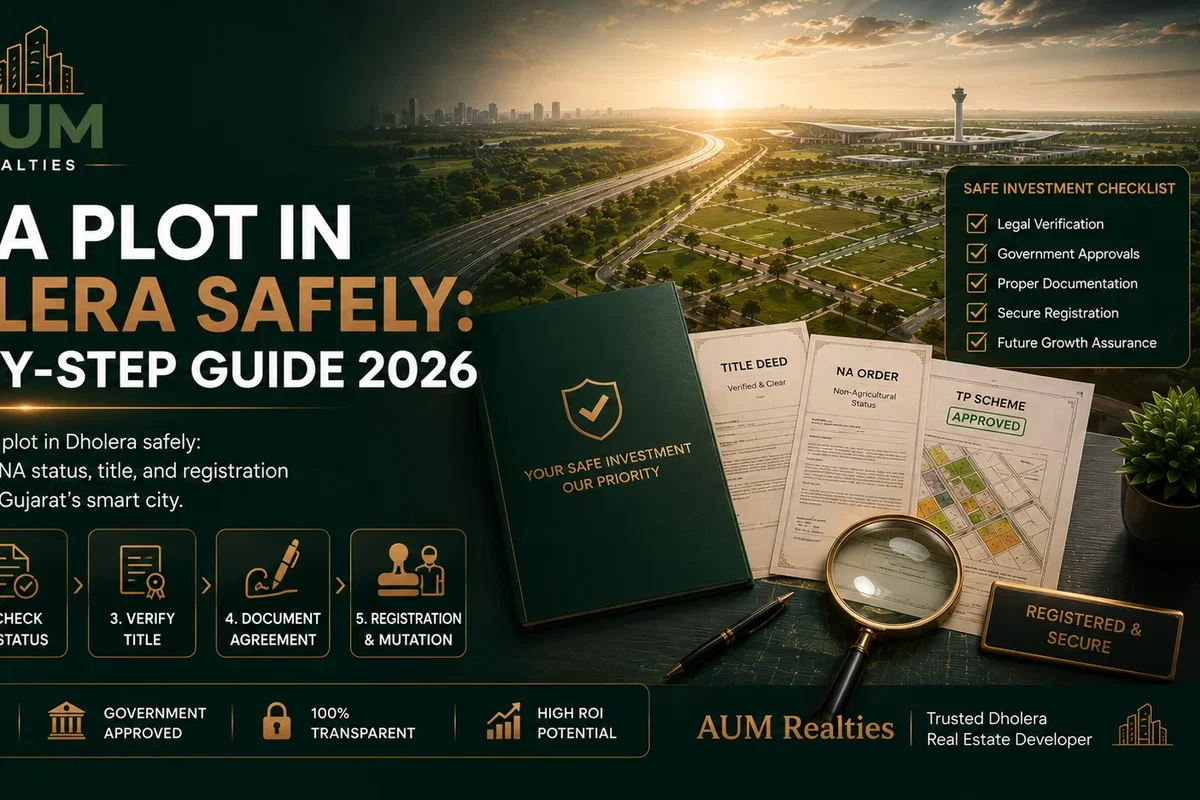
G. Step-by-Step Process to Buy a Plot in Dholera Safely
Following a structured purchase process reduces the likelihood of legal, financial, and documentation issues. Completing each step in order ensures you make informed decisions before registering the property.
A safe land purchase follows a structured process: shortlist legally verified plots, complete legal due diligence, negotiate transparent terms, register the Sale Deed, and update mutation records after registration. Following these steps helps protect ownership rights and minimizes legal and financial risks.
Step 1: Shortlist Verified Plots
Start by shortlisting plots within approved TP schemes, cross-checking each against DSIRDA official scheme documentation rather than relying solely on developer brochures.
Step 2: Complete Legal Due Diligence
Before making any payment, complete the legal due diligence process described above and ensure all ownership, title, zoning, and regulatory documents have been independently verified. Where applicable, confirm the project's registration through the Gujarat Real Estate Regulatory Authority (GujRERA) Portal.
Step 3: Negotiate Price and Terms
Negotiate based on verified comparable pricing within the same TP scheme and land-use category, not headline rates from unrelated sectors. Confirm whether the quoted price is per plot or per unit area, and get the final agreed terms in writing.
Step 4: Execute Sale Agreement and Registration
Draft a clear sale agreement covering payment terms, possession timeline, and legal obligations, ideally reviewed by your own lawyer. Execute and register the Sale Deed at the Property Registration Office.
Step 5: Mutation and Post-Purchase Documentation
After registration, apply to update the Land Mutation Records so the revenue records reflect you as the new owner.
H. What Does It Cost to Buy a Plot in Dholera? Taxes, Fees, and Hidden Costs
The advertised plot price is only one part of your investment. The total cost of buying a plot includes more than the purchase price. Buyers should budget for stamp duty, registration charges, legal fees, brokerage, development charges, and any applicable maintenance or documentation costs to estimate the true investment amount accurately.
1. Stamp Duty and Registration Charges Explained
In Gujarat, stamp duty is charged on the higher of the Jantri (government-assessed market value) or the actual agreed transaction value, a rule designed to prevent underdeclaration. As a general reference: residential and commercial property typically attracts a stamp duty rate of around 4.9%, with women buyers receiving a concession, while agricultural-classified land generally attracts a lower rate.
Registration charges are typically around 1% of the applicable value, with exemptions often available for women buyers. Before finalizing your budget, you can directly view the current Jantri rates for Rural Agricultural land and Rural Non-Agricultural land through Gujarat's official GARVI portal.
2. Legal Fees and Documentation Costs
Independent legal review, title search, document verification, and sale deed drafting are necessary costs, not optional ones, and should be budgeted as a fixed percentage of the transaction rather than treated as negotiable.
3. Brokerage and Service Charges
If working through a broker, confirm the brokerage percentage and payment terms upfront in writing, and verify the broker is operating transparently rather than adding undisclosed markups to the seller's asking price.
4. Development Charges and Maintenance Costs
Some projects include development charges for internal roads, boundary demarcation, or community infrastructure; confirm whether these are included in the quoted plot price or billed separately before you commit.
5. Budgeting for Long-Term Ownership
Beyond the purchase itself, budget for property tax, any applicable maintenance charges in developed layouts, and the cost of periodically renewing or verifying documentation status as TP scheme infrastructure progresses.
I. Common Mistakes to Avoid When Buying a Plot in Dholera
Most land-buying mistakes can be avoided through proper due diligence. Understanding the common pitfalls helps you protect your investment and avoid unnecessary legal or financial complications. Most investment mistakes can be avoided through proper due diligence. The biggest risks include purchasing without legal verification, ignoring TP Scheme and zoning requirements, relying on verbal promises, and making decisions based solely on speculative price expectations.
1. Buying Without Legal Verification
Skipping title search, NA verification, or encumbrance checks is the single most common and most expensive mistake in Dholera land transactions.
2. Ignoring TP Schemes and Zoning Restrictions
Buying land without confirming its exact TP scheme and zoning classification can lead to construction denials, resale complications, or eventual disputes with government acquisition plans.
3. Trusting Verbal Commitments Over Documents
Any commitments regarding pricing, possession dates, or infrastructure promises should be captured in writing and, where legally required, in a registered agreement. Verbal assurances offer no recourse if things go wrong.
4. Overpaying Due to Speculative Hype
Comparing only headline prices without checking documentation quality often leads buyers to overpay for land with weaker legal standing than a slightly higher-priced, fully verified alternative.
Frequently Asked Questions
1. Is it safe to buy a plot in Dholera in 2026?
Yes, when the plot falls within an approved TP scheme, has clear NA status and title, and the transaction is completed through registered documentation. Safety depends on the buyer's due diligence, not on Dholera's overall reputation as a growth region.
2. What documents should I verify before buying land in Dholera?
Key documents include the 7/12 extract and Village Form 8A, title deed and ownership chain, Encumbrance Certificate, NA certificate, TP scheme maps, mutation records, and RERA registration details where applicable.
3. How can I check if a Dholera plot has a clear title?
Verify the ownership chain, revenue records, mutation entries, and Encumbrance Certificate as explained in the legal verification section above.
4. Should I buy agricultural land or NA plots in Dholera?
For residential or commercial construction, you need land with confirmed Non-Agricultural (NA) status matching your intended use. Agricultural land cannot legally be built on until it is formally converted, and buying it expecting future construction carries real risk.
5. What are TP schemes, and why do they matter to investors?
TP Schemes define how land is planned, serviced, and developed in Dholera. They influence infrastructure readiness, permitted land use, and future development timelines.
6. What are the hidden costs involved in buying a plot in Dholera?
Beyond the plot price, budget for stamp duty and registration charges (calculated on the higher of the agreed price or the Jantri rate), legal fees, brokerage, any NA conversion charges, and potential development or boundary-demarcation costs.
7. Can NRIs legally buy plots in Dholera?
NRIs can legally purchase non-agricultural residential and commercial plots in India, including in Dholera SIR, under standard Foreign Exchange Management Act, 1999 (FEMA) rules. However, NRIs are generally barred from purchasing agricultural land, farmhouses, or plantation property, so confirming a plot's NA status is especially critical for NRI buyers.
8. What are the biggest mistakes first-time Dholera investors make?
The most common mistakes include buying without proper due diligence, ignoring TP scheme and zoning verification, relying on verbal promises, and overpaying based on speculative marketing.
Disclaimer: This article is for general informational purposes only and does not constitute legal, financial, or investment advice. Land regulations, stamp duty rates, Jantri values, TP scheme statuses, and FEMA rules referenced here are subject to periodic government revision. Always verify current rules and documentation directly with DSIRDA, DICDL, the Gujarat Revenue Department (GARVI portal), GujRERA, and a licensed property lawyer before making any purchase decision.