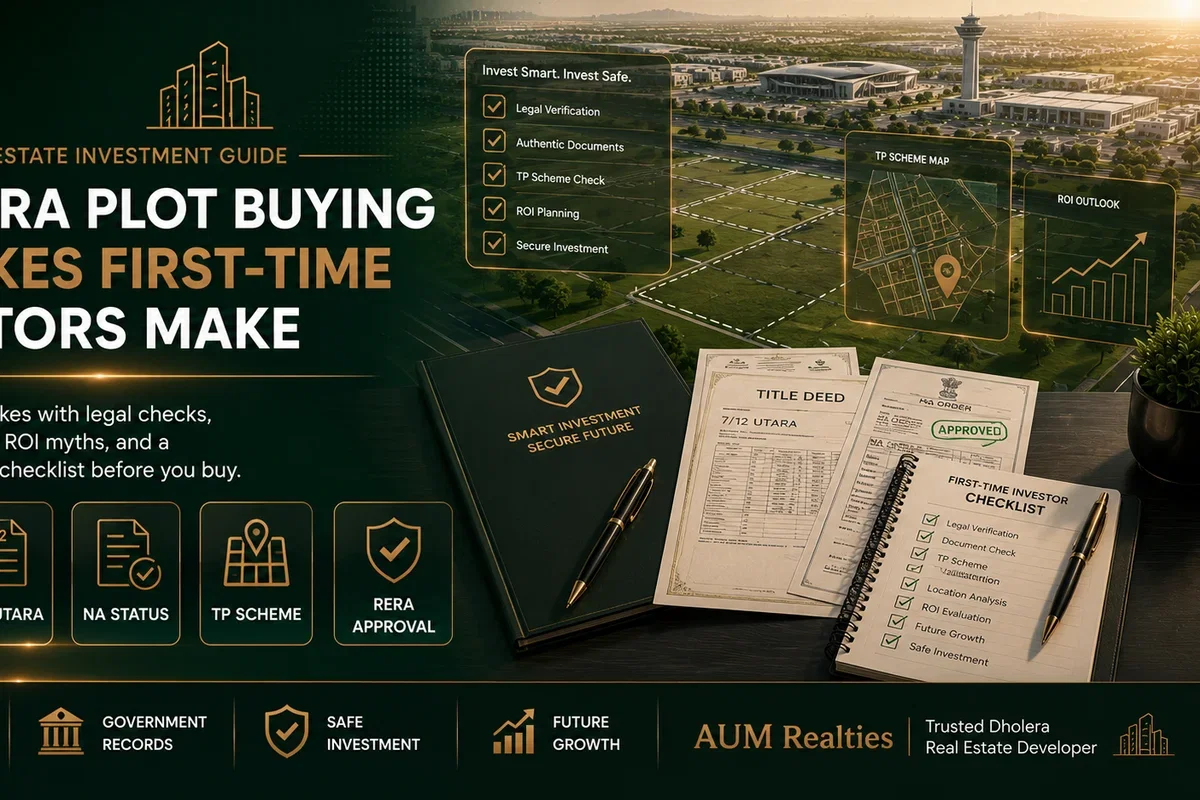
Dholera Special Investment Region (Dholera SIR) has emerged as one of India's most talked-about destinations for land investment. As a key component of the Delhi-Mumbai Industrial Corridor (DMIC) and a project linked to India's Smart Cities Mission, Dholera offers the potential for large-scale industrial growth, enhanced connectivity, and long-term property value appreciation. The vision behind this Greenfield Smart City Project, developed from scratch with government support, is attracting first-time land investors from across the country.
However, interest in this developing region does not necessarily mean that investors fully grasp the nuances of investing there. In recent years, there has been considerable speculation surrounding smart city projects across India, and Dholera is no exception. Many new investors fall prey to aggressive marketing campaigns, exaggerated return projections, and social media hype without verifying critical details such as land ownership rights, zoning regulations, or the actual progress of infrastructure development.
Investing in Dholera plots requires careful evaluation of legal documents, land-use regulations, infrastructure progress, and long-term market potential.
Before making any purchase decision, investors should focus on the following key points:
Key Check | Why It Matters |
Verify land ownership and title documents | Prevents future ownership disputes and legal complications |
Understand TP schemes and zoning regulations | Determines the actual usability and development potential of the plot |
Check NA conversion and approvals | Ensures the land can be legally used for the intended purpose |
Separate planned infrastructure from completed infrastructure | Avoids unrealistic expectations based on future announcements |
Evaluate realistic returns and holding period | Helps investors avoid speculation-driven decisions |
Plan an exit strategy before purchase | Reduces liquidity risks in an early-stage market |
Dholera SIR offers long-term development potential, but successful investment depends on informed decision-making rather than marketing claims or short-term price expectations.
This guide highlights Common Dholera Plot-Buying Mistakes that investors should avoid, explains the reasons behind these challenges, and outlines a practical approach for evaluating plots before making an investment decision. This article has been prepared by real estate professionals with a focus on land investment analysis, property documentation, infrastructure-led development, and emerging real estate markets in Gujarat.
The analysis includes key factors that influence Dholera plot investments, including land ownership verification, Town Planning (TP) Schemes, zoning regulations, infrastructure progress, developer evaluation, and long-term investment risks. Readers should use this information as a research guide and independently verify all property-related information through official government records and qualified professionals before making any investment decision.
A. Why First-Time Investors Make Costly Mistakes When Buying Plots in Dholera SIR
Most first-time buyers lose money not because Dholera lacks potential but because they underestimate how land investing differs from buying apartments or stocks. Successful investors evaluate legal ownership, zoning, infrastructure status, and holding period before considering expected appreciation. Treat every purchase as a long-term infrastructure investment rather than a short-term speculative opportunity.
1. How Dholera Plot Marketing Hype Causes Investment Mistakes
A practical way to avoid the hype is to prepare a verification checklist before proceeding with the project. If a claim cannot be supported by government notifications, approved planning documents, or physical site inspection, treat it as marketing rather than investment information. Early-stage development regions generate excitement long before they generate returns. When buyers act on urgency ("prices will double next year") rather than verified facts, they tend to overpay for unapproved or poorly located land.
2. How Fake Claims and Misinformation Affect Dholera Land Investments
Investors should distinguish between official announcements, tender awards, construction progress, and operational completion. These represent separate milestones, and confusing them often results in unrealistic expectations about price appreciation.
Because Dholera SIR is still being built out in phases, a wide gap exists between what authorities officially sanction and what marketers present as "as good as done." Misinformation spreads fastest around timelines. Promotional content frequently rounds up or exaggerates airport operations, expressway completion, and industrial activation dates.
3. Why FOMO-Based Dholera Investments Often Fail
Creating predefined investment criteria, such as maximum budget, acceptable holding period, and minimum legal documentation, helps reduce emotional decision-making and keeps purchases aligned with financial goals.
Investment decisions driven by FOMO (fear of missing out) rarely account for holding periods, liquidity, or realistic exit timelines. Informed investors treat Dholera as a multi-year infrastructure opportunity, not a quick-flip investment.
4. Common Failure Patterns Among First-Time Buyers
Many investors also overlook transaction costs, registration expenses, and future development charges. Considering the total acquisition cost provides a more realistic picture of expected returns.
Recurring mistakes include buying non-NA (non-agricultural) land while expecting immediate residential use, skipping title verification, trusting verbal broker assurances, and assuming all "Dholera" listings fall within the officially notified SIR boundary.
5. Influence of Brokers and Social Media Marketing Claims
Marketing videos often showcase future master plans instead of existing infrastructure. Asking for current site photographs, approved layouts, and official documentation helps separate promotional content from present-day reality.
A large share of Dholera plot inquiries originates from Instagram, YouTube, and WhatsApp marketing rather than verified government sources. These channels effectively generate leads but do not always disclose zoning restrictions, approval status, or realistic timelines.
B. Understanding Dholera SIR, DMIC, TP Schemes, and Land Planning Before Buying a Plot
Understanding Dholera's planning framework is just as important as evaluating individual plots. Government planning, TP schemes, zoning regulations, and infrastructure sequencing collectively determine whether a parcel becomes more valuable over time or remains difficult to develop.
1. What Is Dholera SIR and Why Is It Important for Land Investors?
Dholera SIR is one of India's first greenfield Special Investment Regions, planned under Gujarat's SIR Act and integrated into the DMIC framework. It aims to become a self-sustaining industrial and urban hub with dedicated zones for manufacturing, logistics, residential, and commercial use.
Unlike conventional township developments, Dholera follows a region-wide master planning approach. Investors should understand that appreciation depends on coordinated regional development rather than isolated private projects.
Dholera SIR should be understood as a regional industrial and urban development zone rather than a single residential township project. Its future value depends on coordinated development of infrastructure, industrial activity, employment generation, and planned urban growth across different zones.
2. How DMIC Connectivity Could Influence Dholera Real Estate Growth
The Delhi–Mumbai Industrial Corridor is the national infrastructure backbone connecting Dholera to major ports, logistics hubs, and industrial clusters across multiple states. Dholera's inclusion in DMIC is a key reason it receives sustained central and state government attention, but it also means Dholera's growth depends on the broader corridor's execution pace, not Dholera alone.
The industrial corridor also improves supply chain efficiency by linking manufacturing clusters with ports, freight corridors, and major consumption centers, making industrial investment more attractive over the long term.
3. How Dholera's Greenfield Smart City Planning Impacts Future Property Value
Dholera is often referenced alongside India's Smart Cities Mission because of its integrated urban planning approach, smart utilities, ICT infrastructure, and planned zoning. It is important to note that this is a separate initiative from the retrofitting-focused Smart Cities Mission applied to existing Indian cities; Dholera is a greenfield development.
Smart infrastructure includes integrated utilities, digital governance, efficient transportation planning, and sustainable urban development, all of which can improve long-term land utilization.
4. Government-Developed Areas vs Private Plotting Schemes in Dholera: Key Differences
Within Dholera SIR, land falls into two broad categories: government-developed activation areas, where authorities are building trunk infrastructure such as roads, drainage, and utilities, and privately marketed plotting schemes surrounding or adjacent to the SIR.
These categories carry very different risk profiles. Comparing multiple projects across both government-supported and private areas provides better context than relying on a single developer's presentation.
5. How Residential, Industrial, and Commercial Zoning Affects Dholera Plot Value
Land-use zones, including residential, industrial, commercial, or agricultural classifications, directly determine what you can legally build and when. A plot marketed as "prime residential" may actually fall within an agricultural or industrial-designated zone until authorities formally convert it. Future rezoning may happen, but investors should never assume it while evaluating a property. Investment decisions should always rely on the current approved land-use designation.
6. Planned vs Completed Infrastructure in Dholera: What Investors Should Verify
There is a meaningful difference between infrastructure that authorities have planned, sanctioned, started constructing, and fully operationalized.
Treat each stage separately:
Whenever possible, review publicly available progress reports, engineering updates, or satellite imagery alongside official announcements to understand the actual development status.
C. How to Evaluate a Dholera Plot Before Buying: A 10-Step Verification Process
Before purchasing land in Dholera SIR or nearby development areas, investors should follow a structured verification process:
1. Verify Survey Number and Land Records:
Confirm the exact survey number and ownership details through Gujarat government land records.
2. Check Complete Ownership History
Review the title chain to ensure there are no ownership disputes or unclear transfers.
3. Confirm NA Conversion Status
Verify whether the land has received non-agricultural conversion approval for the intended use.
4. Understand TP Scheme Details
Check whether the plot falls under a Town Planning Scheme and verify the final plot details.
5. Confirm Land-Use Zoning
Ensure the current zoning matches your investment objective, whether residential, commercial, or industrial.
6. Verify Layout Approval
Confirm that the plotting layout has approval from the relevant authority.
7. Inspect Actual Site Infrastructure
Check current road access, electricity availability, drainage, and water infrastructure.
8. Evaluate Developer Credentials
Review past projects, documentation transparency, and approvals.
9. Calculate Complete Investment Cost
Include registration charges, development costs, maintenance expenses, and other applicable fees.
10. Define Your Exit Strategy
Decide on your expected holding period and identify realistic future buyers before investing.
D. Mistake 1: Buying Dholera Plots Without Legal Verification
Legal verification protects investors from disputes that may not become apparent until resale or construction. Spending time and money on legal due diligence before purchase is usually far less expensive than resolving ownership issues later.
1. How Illegal Plotting Schemes and Land Scams Work in Dholera
Unauthorized plotting schemes typically sell subdivided agricultural land without converting it to non-agricultural (NA) status or securing layout approval. Buyers usually discover the problem only when they attempt to register the sale deed or apply for a building permit.
2. How to Verify Dholera Land Records Before Buying a Plot
Before paying any token amount, verify the survey number and village records (7/12 extract or equivalent in Gujarat's revenue records), and confirm that the land is not under litigation, reserved for government acquisition, or encumbered.
3. Why Title Chain Verification Is Critical for Dholera Plot Buyers
A clean, unbroken title chain covering multiple ownership transfers reduces the risk of future ownership disputes. A property lawyer should conduct this verification rather than the selling broker.
4. NA Conversion vs Residential Approval: What Dholera Investors Must Know
Many first-time buyers assume "NA plot" and "residential plot" mean the same thing. NA (non-agricultural) conversion is a prerequisite for residential or commercial use, but it does not automatically confirm layout approval or make the plot development-ready.
5. How to Check Dholera Land Ownership Using AnyROR Records
Cross-check ownership and encumbrance status through Gujarat's official land record portals, such as AnyROR, and the sub-registrar's office, rather than relying solely on documents provided by the seller.
6. Role of Legal Consultation Before Purchase
An independent real estate lawyer,r one who is not referred by the seller or broker, should review the title, encumbrance certificate, and sale agreement before you sign anything.
E. Mistake 2: Ignoring Dholera TP Scheme and Land Zoning Rules
TP schemes influence future infrastructure allocation, road access, public amenities, and final plot usability, not just ownership boundaries. Investors must understand how these planning mechanisms affect the actual development potential and long-term value of a plot.
1. What Is a Town Planning (TP) Scheme and How Can It Affect Dholera Plots?
Gujarat's Town Planning (TP) Scheme mechanism works as a land pooling and readjustment tool where original landowners contribute a portion of their land in exchange for developed, serviced plots after authorities build infrastructure. It serves as the primary legal framework that shapes land allotment inside Dholera SIR.
2. How Dholera TP Schemes Convert Original Plots Into Final Plots
Under a TP scheme, authorities reconstitute original (pre-final) plot numbers into final plot numbers after they develop roads, drainage systems, and other services. A plot's pre-final number and final number may refer to different boundaries and sizes, which many marketing materials fail to explain clearly.
Understanding the TP Scheme Process:
The Town Planning Scheme process generally involves:
Original Land Parcel
↓
Town Planning Scheme Preparation
↓
Land Readjustment and Infrastructure Planning
↓
Roads, Utilities, and Public Reservations Allocation
↓
Final Plot Allocation
Investors should verify whether the plot being marketed refers to the original land parcel, preliminary plot, or final plot because these terms can represent different locations, boundaries, and development conditions.
3. Residential vs Industrial vs Commercial Zoning
Each TP scheme designates zones for specific uses. Buying a "residential" plot in an area that authorities eventually classify as industrial, or purchasing an industrial-zone plot expecting residential development, can significantly affect both usability and resale value.
4. Why Zoning Determines Long-Term Value
Zoning is not just a planning formality; it determines what owners can legally build on a plot. Since permitted land use directly influences demand, development possibilities, and future appreciation, investors should verify zoning before making a purchase decision.
5. How to Verify Dholera TP Maps and Final Plot Numbers
TP scheme maps published by the Dholera Industrial City Development Limited (DICDL) or the relevant town planning authority show final plot boundaries, road widths, and reserved areas. Always match the plot being sold with the latest approved TP map instead of relying on older documents or informal sketches.
6. What Does a "Developed Plot" Actually Mean in Dholera?
A plot marketed as "developed" may only have boundary demarcation and may not include actual road access, drainage connections, or electricity supply. Ask specifically what infrastructure exists on-site today rather than relying on what the overall TP scheme plans to provide in the future.
F. Mistake 3: Believing Unrealistic Dholera Plot ROI Claims
Historical appreciation alone should never determine future investment decisions. Actual economic activity and infrastructure completion remain the strongest long-term value drivers.
1. How Dholera Real Estate Sellers Create Unrealistic ROI Expectations
Some marketing materials project appreciation multiples (2x, 4x, or more) based on historical patterns from unrelated cities rather than Dholera's own documented price history and current execution pace.
2. Market Speculation vs Infrastructure-Led Growth
Land prices driven purely by speculation can rise and fall quickly. Sustainable appreciation depends on actual infrastructure delivery, completed roads, operational utilities, and industrial occupancy rather than announcements alone.
3. How Long Does It Take for Greenfield Smart Cities Like Dholera to Develop?
Greenfield smart cities globally often take a decade or more to achieve meaningful population growth and industrial density. Investors should plan around multi-year, not multi-month, appreciation cycles.
4. Why Early-Stage Infrastructure Delays Matter
Large infrastructure projects, including airports, expressways, and rail links, often experience timeline revisions due to regulatory approvals, land acquisition challenges, and construction logistics. Investors should build a buffer into their expectations rather than relying on the earliest projected completion dates.
5. What Dholera Can Learn From GIFT City and Other Planned Cities
Cities such as GIFT City (Gujarat) and Naya Raipur demonstrate that planned urban developments can take considerably longer to mature than initial marketing projections suggest, even with strong government support.
6. Psychological Bias: "Get Rich Early" Mindset
The desire to enter "before everyone else" can override proper due diligence. A practical investment approach treats early entry as a long-term opportunity with calculated risks, not as a guaranteed shortcut to wealth.
G. Mistake 4: Choosing Dholera Plot Developers Without Verification
Documentation, previous project execution, financial transparency, and customer support matter more than marketing quality when evaluating a developer or plotting project.
1. How to Verify Genuine Dholera Plot Developers and Projects
Check a developer's track record of completed projects, registration status, and ability to provide original title documents and approvals upon request. Do not rely only on brochures or promotional presentations.
2. Importance of Approvals and Registrations
Confirm layout approval from the competent town planning authority, NA conversion certificates, and any applicable development permissions before booking a plot.
3. How to Check Gujarat RERA Registration for Dholera Projects
The Real Estate (Regulation and Development) Act, 2016 (RERA), applies to qualifying real estate projects in Gujarat. Where applicable, check the project's RERA registration number on the Gujarat RERA portal and verify that the details match the information provided in marketing materials.
4. Red Flags in Pre-Launch Marketing
Be cautious of:
"Limited-time" pricing pressure
Guaranteed buyback promises
Projects that cannot provide specific survey numbers
Missing approved layout plans
A genuine project should provide clear documentation when requested.
5. Government-Backed vs Private Consortium Projects
Plots within officially notified activation areas developed by the Dholera Industrial City Development Limited carry a different risk and documentation profile compared with privately marketed schemes in surrounding villages.
H. Mistake 5: Confusing Dholera Infrastructure Plans With Ground Reality
Investors should evaluate infrastructure using measurable milestones, such as completed roads, utility connections, operational facilities, and industrial occupancy, rather than relying only on future announcements.
1. What Infrastructure Is Actually Completed in Dholera SIR Today?
As of 2026, several major projects have shown significant progress. The Dholera Expressway has opened, and the Dholera airport has completed key construction milestones, including runway work, with operations targeted for 2026. However, a completed runway does not mean the airport has started operations with scheduled flights. Investors should always confirm the current development phase instead of relying only on the final project vision.
Infrastructure Verification Checklist
Before considering infrastructure as an investment advantage, investors should verify:
Infrastructure Area | What to Check |
Roads | Actual road connectivity reaching the plot |
Airport | Construction status versus operational status |
Electricity | Availability of active power connections |
Water Supply | Existing supply infrastructure |
Drainage | Functional drainage network |
Industrial Development | Operational businesses versus announced projects |
A major infrastructure announcement does not automatically mean every nearby plot benefits immediately. Location-specific verification remains essential.
2. Roads, Water, Electricity, and Connectivity Updates
Trunk infrastructure, arterial roads, water supply lines, and power substations are furthest along in the officially designated activation areas. Infrastructure status varies significantly by specific TP scheme and zone, so a claim about "Dholera" broadly may not apply to your specific plot.
3. Dholera Airport and Expressway Status: What Investors Should Know
The Ahmedabad–Dholera Expressway has significantly reduced travel time between the two cities.
The international airport, developed by Dholera International Airport Company Limited (a joint venture involving the Airports Authority of India, the Gujarat government, and NICDIT), has progressed through construction and licensing stages, with various sources citing operational timelines through 2026.
Investors should treat any specific opening date as provisional until authorities officially confirm it.
4. Are Industries Actually Coming to Dholera? Current Industrial Progress Explained
Industrial activity is gaining momentum, with government and corporate interest linked to sectors such as semiconductors, electronics, and logistics. However, operational factories and actual industrial occupancy currently represent a smaller portion of the total planned industrial area.
5. Timeline Mismatches and Their Investment Impact
When actual delivery delays publicized timelines, plots purchased with expectations of quick appreciation may remain less liquid for longer than expected. Investors should factor these possibilities into their holding period rather than focusing only on the purchase price.
6. Marketing Exaggeration vs Ground Reality
Where possible, verify infrastructure claims through official sources such as Dholera Industrial City Development Limited (DICDL), National Industrial Corridor Development and Implementation Trust (NICDIT), and Airports Authority of India (AAI), or through recent independent site visits.
I. Mistake 6: Ignoring Dholera Plot Resale Liquidity and Exit Planning
A profitable investment begins with a clear exit plan. Investors should understand when they intend to sell, what market conditions they require, and how liquidity may influence pricing.
1. Why Liquidity Matters in Land Investments
Unlike listed securities, land in an early-stage development zone does not have a continuous and transparent market price. Finding a buyer at your expected price may take significantly longer than anticipated.
2. Who Will Buy Your Dholera Plot When You Want to Sell?
At the current stage, resale demand mainly comes from other investors rather than end-users planning immediate construction. This creates liquidity risk because demand can change if investor sentiment shifts.
3. How Long Should You Hold a Dholera Plot Investment?
Considering the long-term infrastructure development involved, investors should generally view Dholera plots as multi-year investments rather than short-term opportunities. Plan your finances carefully and avoid investing money that you may need in the near future.
4. Exit Timing Strategies
Consider aligning exit expectations with major infrastructure milestones, such as:
These milestones often influence buyer demand more directly than a fixed calendar date.
5. Liquidity Risk vs Long-Term Appreciation Balance
Higher potential appreciation in an early-stage development zone usually comes with lower short-term liquidity. Investors should allocate only capital that they can keep invested for an extended period without financial pressure.
6. Challenges in Selling Early-Stage Plots
Plots without clear title documentation, layout approval, or basic road access are generally harder to resell, regardless of their location. Future buyers will face the same verification challenges, making proper documentation essential from the beginning.
J. Mistake 7: Trusting Dholera Property Brokers Without Independent Verification
Treat brokers as one source of information rather than the final authority. Independent verification reduces legal risk and improves negotiating power.
1. Common Dholera Plot Selling Tactics Investors Should Watch For
Common tactics include:
Creating artificial urgency ("only 2 plots left")
Making verbal promises that do not appear in the sale agreement
Discouraging buyers from seeking independent legal verification
2. How Misinformation Spreads in Real Estate Markets
Unverified claims about infrastructure timelines or price appreciation often spread across multiple listings and social media channels. Repeated claims can appear independently confirmed even when they originate from a single marketing source.
3. Government Websites to Verify Dholera Plot Information
Always compare broker claims against:
Do not rely on verbal assurances when official records are available.
4. Independent Verification Checklist
Before purchasing, verify at a minimum:
Survey number
Current land-use classification
TP scheme final plot number (where applicable)
Encumbrance status
Seller's ownership documents
Complete these checks independently of the broker.
5. Importance of Legal Due Diligence Over Verbal Promises
Any factor that affects your purchase decision, including infrastructure timelines, layout approval, or buyback terms, should appear in the sale agreement.
6. How to Avoid Commission-Driven Decisions
Since brokers typically earn commissions after completing sales, they may have an incentive to close transactions quickly. Hiring an independent lawyer or consultant who works separately from the transaction helps create a more balanced decision-making process.
K. Dholera Plot Buying Checklist: Documents and Checks Before Investing
A standardized due diligence checklist reduces investment risk by ensuring every important legal, technical, financial, and planning factor is reviewed before committing funds.
1. Legal Verification Checklist
Confirm the following before purchasing:
Investors should verify these details through official records and qualified legal professionals instead of relying only on seller-provided documents.
2. TP Scheme Confirmation Steps
Verify the plot's pre-final and final plot numbers against the latest approved TP scheme map. Confirm that the zone classification matches the purpose for which the seller is marketing the property.
Dholera's planning framework uses Town Planning Schemes to organize land development, infrastructure allocation, and serviced plot creation. Investors should understand how the specific TP scheme affects their individual plot rather than evaluating Dholera only at a city-wide level.
3. Developer Credibility Checklist
A developer's marketing quality should never replace verification of legal and technical documents.
Verify legal and technical documents:
Registration status
RERA number (where applicable)
History of delivered projects
Ability to provide original documentation
Transparency regarding approvals and ownership records
4. Infrastructure Verification Points
Confirm what physical infrastructure exists at the site today, including:
Road access
Water availability
Drainage systems
Electricity connections
Separate completed infrastructure from the plans and proposed developments.
5. ROI Realism Assessment
Base appreciation expectations on:
Avoid relying on guaranteed returns, projected price multiples, or comparisons with unrelated markets.
6. Exit Strategy Planning Framework
Define:
Do not invest funds that you may need for short-term financial commitments.
L. Future Growth Potential of Dholera SIR: Industrial Development, Infrastructure, and Property Demand
Future appreciation depends on sustained industrial investment, population growth, employment generation, and infrastructure utilization rather than announcements alone. Investors should monitor measurable economic indicators over time instead of relying only on future projections.
1. Government Long-Term Development Vision
Dholera SIR remains a priority project under India's industrial corridor strategy, with continued involvement from the central and Gujarat governments in areas such as land development, utilities, and connectivity infrastructure.
2. Industrial Corridor Impact on Demand
As a designated DMIC node, Dholera benefits from national logistics and manufacturing infrastructure planning. The industrial corridor can improve connectivity between manufacturing clusters, ports, and markets, which may support future industrial demand as development progresses.
3. Expected Economic Drivers (Manufacturing, Logistics)
Manufacturing, electronics, semiconductors, and logistics are among the sectors expected to influence Dholera's future economic activity.
However, investors should differentiate between:
When assessing future demand.
4. Realistic Timeline for Full Development
Comparable greenfield smart cities worldwide usually require one to two decades to achieve significant population density and complete urban maturity. Investors should evaluate Dholera with a long-term development perspective rather than expecting immediate transformation.
5. What Makes Dholera Different From Other Smart Cities
Dholera combines:
A dedicated Special Investment Region framework
DMIC integration
Government-supported infrastructure development
Planned industrial and urban zones
These factors distinguish Dholera from many private township projects that depend primarily on individual developers.
6. Long-Term vs Short-Term Investor Mindset
Investors who approach Dholera with a long-term mindset and track infrastructure execution are better positioned than those expecting rapid short-term appreciation. The strongest investment decisions come from evaluating legal clarity, location quality, infrastructure progress, and realistic timelines together.
M. Risks Every Dholera Investor Should Understand
Although Dholera SIR has significant long-term development potential, investors should also consider possible risks:
1. Development Timeline Risk
Large infrastructure projects can experience delays due to approvals, construction challenges, or changing priorities.
2. Liquidity Risk
Unlike established real estate markets, early-stage development areas may take longer to find buyers at expected prices.
3. Regulatory Risk
Land-use rules, zoning classifications, and approval requirements directly affect plot usability.
4. Location Selection Risk
Not every plot within or around a developing region benefits equally from future growth.
5. Market Demand Risk
Long-term appreciation depends on actual industrial growth, population movement, and economic activity.
FAQ about Mistakes Made When Buying Plots in Dholera
1. What are the biggest Dholera plot-buying mistakes?
The most common mistakes are skipping legal title verification, misunderstanding TP scheme zoning, trusting inflated ROI claims, and relying on broker assurances instead of independent due diligence.
2. Is it safe to invest in Dholera SIR in 2026?
Investing in officially notified, title-verified, NA-converted land within Dholera SIR carries the standard risks of any early-stage development zone. Safety depends heavily on individual due diligence rather than the region's overall reputation.
3. How do I verify if a Dholera plot is legal?
Check the survey number and title chain through Gujarat's official land records (AnyROR), confirm NA conversion status, and verify there's no litigation or government reservation, ideally with an independent lawyer.
4. What is the TP scheme in Dholera and why is it important?
The Town Planning Scheme is Gujarat's land pooling mechanism that determines how original land is reconstituted into final, serviced plots. It directly affects a plot's actual boundaries, zoning, and development timeline.
5. Can I trust brokers selling Dholera plots?
Broker information should always be independently verified against government records and TP maps rather than accepted on its own, since brokers are typically incentivized by commission on closed sales.
6. What is the real ROI expected in Dholera SIR?
Realistic returns depend on actual infrastructure delivery and holding period rather than marketed projections; appreciation multiples advertised by sellers should be treated as unverified estimates, not guarantees.
7. How long will Dholera take to fully develop?
Comparable greenfield smart cities have taken a decade or more to reach full development. Investors should plan around a multi-year to multi-decade horizon rather than short-term timelines.
8. Is resale possible in Dholera real estate?
Resale is possible, but liquidity is currently limited compared to established markets, since demand is largely investor-driven rather than end-user-driven at this stage.
9. What documents should I check before buying land in Gujarat?
At a minimum: the 7/12 extract or equivalent revenue record, title chain documents, encumbrance certificate, NA conversion certificate, and (where applicable) RERA registration and approved layout plan.
10. What is the difference between approved and non-approved plots in Dholera?
Approved plots have completed NA conversion and layout approval from the relevant town planning authority, while non-approved plots may lack legal clearance for residential or commercial construction, creating higher legal and resale risk.
Key Takeaways.
Investors should verify property-related information through reliable sources, including:
Dholera Industrial City Development Limited (DICDL) for planning and development information
Gujarat government land record portals for ownership verification
Gujarat RERA portal for applicable registered projects
National Industrial Corridor Development Corporation (NICDC) for corridor-related information
Airports Authority of India (AAI) for airport-related updates
Independent verification from official sources is recommended before making any land purchase decision.
Disclaimer: The information in this blog is for general informational purposes only. Prices and market insights are indicative and subject to change based on location, infrastructure, government policies, and market conditions. Readers should verify all information independently and consult qualified legal, financial, or real estate professionals before making any investment decisions.
This article is intended for general informational purposes and does not constitute legal or financial advice. Land investment carries risk, and readers should consult a qualified real estate lawyer and financial advisor, and verify all details directly with official government sources (DICDL, Gujarat RERA, AnyROR) before making any purchase decision.