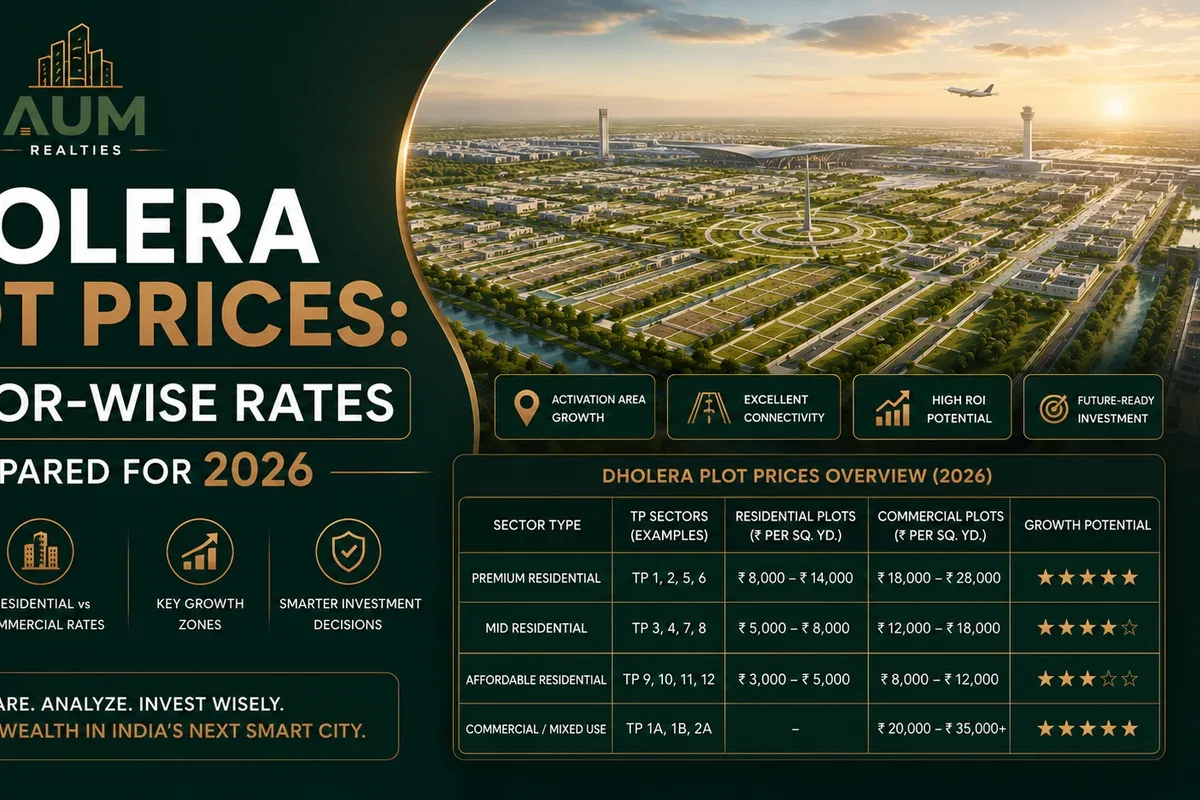
While many buyers compare Dholera plot prices based solely on the quoted rate per sq. yard, our review of publicly available listings, government planning documents, and infrastructure updates indicates that pricing is primarily influenced by infrastructure readiness, TP Scheme progress, land-use zoning, and proximity to major development corridors. Dholera Plot Prices by Sector provide a more accurate perspective, as land values tend to increase alongside verified project execution rather than speculative market activity, making sector-wise analysis an essential part of informed investment planning.
Dholera plot prices are not a single number; they change from one Town Planning (TP) sector to the next based on how close a plot sits to the Activation Area, how developed the surrounding infrastructure is, and whether the land falls inside or outside the official Dholera Special Investment Region (SIR) boundary. For anyone comparing plots across sectors, understanding why rates differ is just as important as knowing the rates themselves.
Dholera plot prices vary according to sector location, infrastructure access, proximity to activation zones, connectivity projects, commercial demand, and future industrial development plans.
Dholera SIR spans roughly 920 sq. km and covers 22 villages inside the SIR boundary and 11 villages outside it, each grouped into different TP schemes. Because the region is being developed in phases under the Delhi Mumbai Industrial Corridor (DMIC) and guided by the Government of Gujarat through Dholera Industrial City Development Limited (DICDL), sectors closest to completed infrastructure roads, water, power, and the Activation Area command a premium. In contrast, peripheral or early-phase sectors remain comparatively affordable entry points.
Quick summary of sector categories:
Category | Typical Profile | Relative Price Level |
Activation Area / TP1–TP2 (Prime) | Closest to the 250-metre central spine, with the highest infrastructure completion | Highest |
TP3–TP5 (Mid-development) | Residential expansion zones, infrastructure in progress | Moderate |
Peripheral SIR sectors | Entry-level pricing within the SIR boundary | Affordable |
Near-SIR villages (outside boundary) | Individual titles, earlier possession, no pooling process | Lowest, higher risk |
This guide breaks down how sector-wise pricing works, what drives the differences, and how to match a sector to your budget and investment timeline.
A. How TP Schemes Influence Dholera Plot Prices
Dholera plot prices differ because every Town Planning (TP) Scheme is at a different stage of infrastructure development. Sectors closer to the Activation Area, expressway, airport, and industrial corridors generally command higher prices, while emerging sectors offer lower entry costs with longer-term appreciation potential.
Unlike conventional urban developments, Dholera SIR follows a government-led land pooling model administered by the Dholera Special Investment Region Development Authority (DSIRDA). Under this framework, land is reorganized into Town Planning (TP) Schemes before being equipped with planned infrastructure such as roads, water supply, drainage, and utility networks. As infrastructure progresses and final plots become more usable, market demand and property values generally improve.
1. Why Dholera Plot Prices Differ from Other Indian Real Estate Markets
Unlike conventional land development, Dholera SIR follows a government-led land pooling model where infrastructure is planned before large-scale urban expansion. This structured approach makes infrastructure progress one of the primary drivers of future land value.
Dholera Special Investment Region is India's first greenfield smart city, planned and executed under a structured land-pooling and town-planning framework rather than the piecemeal development typical of conventional real estate markets. Instead of individual owners developing land independently, DICDL pools land from farmers and landowners, develops infrastructure across the pooled area, and then reallocates "final plots" back to original owners and investors.
This is why pricing inside Dholera SIR behaves differently from a typical suburban plot market: appreciation tends to follow infrastructure milestones rather than speculative demand alone.
Feature | Conventional Real Estate | Dholera SIR |
Development Model | Developer-led expansion | Government-planned smart city development |
Land Planning | Independent layouts | Structured TP Scheme and land pooling model |
Primary Price Driver | Local demand & market sentiment | Infrastructure completion and planned development |
Infrastructure | Often follows development | Planned before large-scale urban expansion |
Appreciation Pattern | Market-driven | Infrastructure and milestone-driven |
2. Price Differences Across Dholera TP Schemes
Every Town Planning (TP) Scheme represents a different development phase. Earlier TP schemes generally have more completed infrastructure, while later schemes provide lower acquisition costs and higher long-term growth potential.
Dholera SIR is organized into multiple TP Schemes, each representing a distinct phase and geography within the region. Town Planning Scheme 1 & Town Planning Scheme 2 are among the most referenced because they sit closest to the Activation Area and have progressed furthest through infrastructure rollout, including wider TP roads and utility connections. Later-stage schemes (TP3 onward) are still being developed, which is reflected directly in their comparatively lower entry prices.
The price ranges shown above are indicative estimates compiled from publicly available property listings, local market observations, and information published by Dholera SIR Developers Association and real estate consultants during 2026. Actual prices may vary depending on plot size, exact location, road frontage, approvals, infrastructure status, and negotiation. Buyers should independently verify current pricing and documentation before making any investment decision.
3. Residential, Commercial & Industrial Plot Prices Compared
Within each TP scheme, land is further zoned by use:
Residential plots in Dholera are generally preferred by first-time buyers, long-term investors, and individuals planning future residential construction because they usually require a lower initial investment.
Commercial and Shop-Cum-Office (SCO) plots in Dholera are more suitable for investors seeking rental income or business opportunities in areas expected to experience higher commercial activity.
Industrial plots in Dholera are generally considered by businesses, manufacturers, and institutional investors looking to establish operations near industrial corridors and major infrastructure projects. These investments often require a larger capital commitment but may benefit from long-term industrial growth.
Because each zone serves a different investor profile and carries a different risk-return relationship, comparing prices only makes sense within the same land-use category.
4. Why the Activation Area Has the Highest Plot Prices
The Activation Area is the first fully serviced, ready-to-develop zone within Dholera SIR, where infrastructure roads, drainage, power, and water have been substantially completed, and possession has begun in several pockets. Plots inside or immediately adjacent to the Activation Area consistently command the highest per-square-yard rates in the region, since they carry the lowest execution risk and the shortest runway to actual construction.
B. Dholera Plot Prices by TP Scheme: Sector-Wise Price Comparison
Dholera plot prices vary by sector because of infrastructure readiness, connectivity, land use, and future development plans. Premium sectors near the Activation Area typically have higher prices than emerging or peripheral sectors.
1. Dholera Plot Price Table by TP Scheme
Because Dholera is still a developing market with prices quoted differently by developer, plot size, and exact micro-location, the ranges below should be treated as approximate, illustrative bands rather than fixed quotes. Always verify current pricing directly with DICDL-approved sellers or licensed consultants before transacting.
Sector / Zone Type | Approximate Price Range (per sq. yard) | Notes |
TP1 (near Activation Area) | ₹14,000 – ₹16,000+ | Highest demand, with 55-metre TP road frontage in select locations |
TP2 (Activation Area core) | ₹11,000 – ₹15,000+ | Fully serviced pockets, premium residential,l and SCO plots |
TP3–TP5 (Mid-development) | ₹9,000 – ₹12,000 | Infrastructure under development with strong appreciation potential |
Peripheral SIR sectors | ₹8,000 – ₹9,000 | Entry-level pricing within the SIR boundary |
Near-SIR villages (outside boundary) | ₹5,000 – ₹9,000 | Individual land titles, lower infrastructure certainty |
Industrial land (near anchor projects) | Highly variable; can exceed ₹1 crore per plot in prime locations | Pricing driven by proximity to major manufacturing and industrial investments |
2. Residential Plot Prices by TP Scheme (TP1–TP5)
Residential plot prices increase as infrastructure becomes operational. Investors usually pay a premium for sectors with completed roads, utilities, and easier access to major infrastructure projects.
Residential plots remain the most searched category among individual buyers and NRIs. Entry-level residential plots in outer or peripheral sectors are still accessible for early-stage investors, while premium residential plots inside TP1 and TP2, closer to the central spine and the Activation Area, require a considerably higher budget. Some listings for compact residential plots near the SIR boundary have been quoted at roughly ₹11 lakh per plot, illustrating how the entry point can shift depending on the sector.
3. Commercial Plot Prices Across Major Dholera Sectors
Commercial and SCO plots are priced on a different scale than residential land, largely because supply is more limited and demand is tied to proximity to planned business hubs, the ABCD Building (Administrative, Business, Commercial, and Data hub), and major transport corridors. SCO plots in TP1, for instance, have been priced noticeably higher than comparable listings in TP4, largely because of their nearness to the Activation Area and wider road frontage.
4. Premium vs Affordable Dholera Sectors: Price & ROI Comparison
Premium sectors generally offer lower investment risk and earlier usability, whereas emerging sectors may provide greater percentage appreciation for investors willing to hold their investment longer.
Premium sectors, generally TP1 and TP2, offer the lowest execution risk but the highest entry cost. Emerging zones such as TP3–TP5 offer a lower entry price with the trade-off of a longer runway before infrastructure and possession are finalized. Investors comfortable with a 5–10-year horizon often find that emerging sectors offer stronger percentage appreciation, even if absolute prices remain lower today.
5. Average Dholera Plot Price Per Square Yard and Square Metre
For quick reference when comparing listings quoted in different units:
1 square yard ≈ 0.836 square metres
A plot priced at ₹10,000 per sq. yard is roughly equivalent to ₹11,960 per sq. metre
Always confirm which unit a listing uses before comparing sectors, since mixing sq. yard, sq. metre, and sq. ft. figures is one of the most common pricing mistakes new investors make
C. Factors Affecting Dholera Plot Prices
The biggest factors influencing Dholera plot prices include TP Scheme location, airport proximity, expressway connectivity, industrial investments, government infrastructure development, and overall market demand.
1. Airport Proximity and Its Impact on Plot Prices
Airport infrastructure often increases nearby land demand by improving accessibility, supporting logistics businesses, attracting commercial investment, and creating long-term employment opportunities.
The Dholera International Airport is one of the single largest catalysts behind sector-wise price differences. Sectors and villages closest to the airport corridor have seen the sharpest rate increases as construction has progressed toward Phase 1 completion, since airport proximity typically drives both residential demand (for future employment) and commercial demand (for logistics and hospitality).
The Dholera Airport is expected to improve regional connectivity and support logistics, aviation-related businesses, hospitality, and commercial development. Sectors located closer to the airport corridor often experience stronger buyer interest due to anticipated economic activity.
2. Ahmedabad-Dholera Expressway Price Impact
Better road connectivity typically improves property demand because it reduces travel time, increases accessibility, and enhances the attractiveness of nearby residential and commercial developments.
The Ahmedabad-Dholera Expressway has substantially cut travel time between Ahmedabad and the SIR, and sectors along or near this corridor consistently command a location premium over sectors that require longer approach roads. As the expressway has become fully operational, this premium has become more pronounced in near-SIR and periphery pricing as well.
Improved road connectivity reduces travel time between Ahmedabad and Dholera, making nearby sectors more accessible for residents, businesses, and investors. Better accessibility typically contributes to higher demand and improved long-term property values.
3. Industrial Projects Driving Dholera Land Prices
Large anchor investments, most notably semiconductor and electronics manufacturing projects within the region, have a direct, visible effect on nearby industrial and even residential land rates, as they signal real employment generation rather than speculative demand alone.
Large-scale industrial projects, including semiconductor, electronics, renewable energy, and manufacturing investments, generate employment opportunities and increase demand for residential, commercial, and industrial land in surrounding sectors.
4. Government Infrastructure Development as a Price Driver
Continued spending by the Government of Gujarat and DICDL on roads, utilities, and social infrastructure (schools, hospitals) inside TP1 and the Activation Area is a key reason those sectors have moved from "paper project" status to livable, serviced land and are priced accordingly.
Infrastructure such as TP roads, water supply, drainage, electricity, public utilities, schools, and healthcare facilities contributes significantly to property value. Sectors where these developments are operational generally command higher prices than areas where infrastructure is still under construction.
5. Supply, Demand & Future Growth Corridors Explained
As TP schemes progress and DSIRDA (Dholera Special Investment Region Development Authority) releases more final plots inside the SIR, the price gap between "inside SIR" and "near SIR" sectors is gradually narrowing, a trend worth watching for investors comparing sectors on a multi-year timeline.
As infrastructure progresses and more investors enter the market, demand for well-located plots may increase while the availability of premium plots becomes relatively limited, contributing to gradual price appreciation.
D. Residential vs Commercial Plot Prices in Dholera: Which Offers Better Value?
Residential plots generally have lower entry costs, while commercial plots command higher prices due to business potential, limited supply, and strategic locations near major transport corridors.
1. Residential Plot Price Comparison by Sector
Residential plots generally sit at the lower end of the per-square-yard scale compared to commercial and SCO plots in the same sector, making them the more accessible entry point for first-time investors across almost every TP zone.
2. Commercial Plot Prices in Prime Growth Corridors
Commercial land near growth corridors, particularly close to the ABCD Building, expressway junctions, and the airport approach road, carries a structural premium over residential land in the same TP scheme, reflecting its more limited supply and dual-income potential.
SCO (Shop-Cum-Office) plots are increasingly attractive to investors seeking a dual-use model: commercial activity at ground level with residential or rental use above, a format gaining traction as Dholera's resident and workforce base grows alongside its industrial anchors.
3. Residential vs Commercial: Which Offers Better ROI?
Neither category is uniformly "better"; residential plots typically offer a lower entry cost and broader resale liquidity, while commercial and industrial land typically offer a higher entry cost but stronger absolute appreciation if positioned correctly near confirmed growth corridors. The right category depends on your budget, risk tolerance, and whether you're investing for capital appreciation or future income generation.
E. Best Dholera Sectors Based on Budget and Investment Goals
The ideal sector depends on your investment objective. Budget-conscious buyers often consider developing TP schemes, while investors seeking earlier infrastructure readiness generally prefer sectors closer to the Activation Area.
Sector Category | Best For | Investment Horizon | Risk Level |
TP1 & TP2 | Investors seeking established infrastructure and lower execution risk | 5–10 Years | Low to Moderate |
TP3–TP5 | Investors targeting long-term capital appreciation | 7–10+ Years | Moderate |
Peripheral SIR Sectors | Budget-conscious investors | 8–12 Years | Moderate to High |
Near-SIR Villages | Experienced investors seeking lower entry prices | Long-Term | Higher |
1. Best TP Schemes for First-Time Investors
Peripheral SIR sectors and mid-development TP zones (TP3–TP5) tend to suit first-time investors best, offering a lower entry price while still sitting inside the officially pooled and planned SIR boundary.
2. High-Growth TP Sectors Near the Airport and Expressway
Sectors near the airport corridor and expressway junctions have shown the fastest recent price movement, making them worth prioritizing for investors focused on medium-term appreciation.
3. Best Premium Sectors for Commercial Investment
TP1 and TP2, closest to the Activation Area and the ABCD Building, remain the top choices for commercial and SCO buyers seeking the lowest execution risk and immediate infrastructure access.
H3: Affordable Dholera Sectors with High Appreciation Potential
Near-SIR villages just outside the official boundary offer the lowest entry price in the broader Dholera growth corridor, though they carry different legal and infrastructure risk profiles since they fall outside DSIRDA's pooling process.
4. Choosing the Right TP Scheme for Your Budget
Investors should first define their budget, expected holding period, and investment objective before comparing sectors. Matching these factors helps identify suitable locations with appropriate risk and return potential.
Entry-level budgets: Consider peripheral SIR sectors or well-documented near-SIR plots with clear individual titles.
Mid-range budgets: TP3–TP5 residential plots offer a balance of reasonable entry cost and infrastructure progress.
Higher budgets: TP1/TP2 residential, SCO, or industrial plots near confirmed anchor projects offer the strongest infrastructure certainty.
F. Historical Price Trends and Future Appreciation Potential
Dholera's price appreciation has historically followed major infrastructure milestones. Future value growth is expected to remain closely linked to continued project execution rather than speculative market activity.
Key Infrastructure Timeline Influencing Plot Prices:
Milestone | Market Impact |
TP Scheme implementation | Established a planned urban development framework |
Ahmedabad–Dholera Expressway construction | Improved regional connectivity and accessibility |
Dholera International Airport development | Increased commercial and residential investment interest |
Major industrial project announcements | Strengthened long-term employment and business prospects |
Ongoing utility and social infrastructure development | Enhanced usability and supported gradual land appreciation |
1. How Dholera Plot Prices Have Changed Over Time
Land rates inside and near Dholera have moved through distinct phases: an early "paper project" phase with minimal infrastructure, followed by a steady climb as TP scheme execution, the expressway, and the airport moved from planning to visible construction. Reported land-rate changes in parts of the broader Dholera locality show double-digit percentage growth even over a single recent year, with cumulative appreciation compounding significantly over three- and five-year windows.
2. Major Infrastructure Milestones That Increased Plot Prices
The most consistently cited price triggers include: the Ahmedabad-Dholera Expressway becoming operational, visible progress on Dholera Airport's Phase 1, the confirmation and construction of large anchor industrial investments, and DSIRDA's phased handover of final plots inside TP1 and the Activation Area.
3. Future Appreciation Potential of Dholera Plot Prices
Because Dholera follows a planned, infrastructure-led appreciation model rather than a purely speculative one, most market analysis frames future gains as gradual and milestone-driven rather than explosive, meaning price movement should track infrastructure completion (airport cargo operations, social infrastructure like schools and hospitals, and further TP scheme handovers) more closely than general market sentiment.
4. Market Outlook for Long-Term Investors
Most independent guides and local consultants converge on a similar message: Dholera is best suited to investors with a 5–10-year holding horizon, prioritizing verified, RERA-registered, SIR-approved plots over unverified peripheral land, since documentation quality has a bigger long-term impact on realized returns than the headline entry price.
G. Legal Considerations Before Buying Plots in Different Sectors
Before purchasing any plot, verify ownership records, TP Scheme status, applicable approvals, land-use permissions, and registration documents to reduce legal and financial risk.
Buyers should independently verify all legal and planning documents using official government resources wherever possible. Important verification sources include the Dholera Industrial City Development Limited (DICDL), Dholera Special Investment Region Development Authority (DSIRDA), Gujarat RERA (where applicable), and official Gujarat land records. Consulting an independent legal professional before completing any transaction can further reduce legal and financial risks.
1. Verifying Ownership and Title Documents
Before comparing prices across sectors, confirm that the seller holds a clear, marketable title, and cross-check the survey number and plot details against official records rather than relying solely on a broker's listing.
2. Understanding TP Schemes and Land Allocation Rules
Each TP scheme has its own allocation and reconstitution rules under DSIRDA's land-pooling process. Understanding which scheme a plot belongs to and whether "final plot" allocation has already occurred materially affects both price and usability timelines.
3. Government Approvals, RERA & Legal Compliance
Buyers should verify Non-Agricultural (NA) land status, layout approval, and RERA registration where applicable, and confirm current status directly through the Government of Gujarat's official Dholera SIR resources rather than relying only on developer marketing material.
4. Common Mistakes When Buying Dholera Plots
- Buying land outside the SIR boundary while it's marketed as "SIR-adjacent" without clarifying actual distance and status
- Skipping verification of NA/NOC status
- Assuming quoted starting prices apply to all plot sizes and locations within a project
- Relying on a single broker's price claim without independent verification
5. Dholera Plot Due Diligence Checklist
A complete due diligence process should include title verification, TP Scheme confirmation, approval checks, infrastructure assessment, price comparison, and independent legal review before making a purchase decision.
1. Confirm TP scheme and final plot status
2. Verify NA/NOC and RERA registration
3. Check survey number against official land records
4. Confirm whether the price quoted is per plot or per unit area
5. Assess current infrastructure completion (roads, power, water) at the specific plot location
6. Get a legal document review from an independent property lawyer
H. How to Choose the Right Dholera Sector for Maximum ROI
Selecting the right sector requires balancing budget, infrastructure readiness, investment horizon, legal clarity, and future development potential rather than focusing only on the lowest available price. Compare only verified plots within similar land-use categories, evaluate infrastructure progress, confirm documentation, and select the sector that best aligns with your long-term investment strategy.
1. Questions Investors Should Ask Before Buying
- Which TP scheme and land-use category does this plot fall under?
- How far is the plot from the Activation Area, expressway, and airport corridor?
- Is the price quoted per sq. yard, per sq. metre, or per plot?
- What is the realistic holding period before construction or resale is feasible?
2. Choosing the Right TP Scheme Based on Your Investment Goal
Investors focused on capital preservation and lower entry cost should lean toward peripheral or mid-development sectors; those focused on near-term usability or business set-up should prioritize TP1/TP2 or confirmed industrial corridors.
3. Infrastructure Checklist Before Buying a Plot
Infrastructure readiness, completed TP roads, active utility connections, and confirmed possession handovers are more reliable price indicators than marketing claims about "upcoming" development.
4. Short-Term vs Long-Term Investment Strategy
Short-term investors (3–5 years) generally benefit more from sectors already showing infrastructure momentum, such as TP1/TP2 or airport-adjacent zones, where appreciation is more visible sooner. Long-term investors (7–10+ years) have more flexibility to consider emerging sectors with lower entry costs and higher relative upside.
5. Step-by-Step Framework for Selecting the Right Sector
1. Define your budget band and land-use goal (residential, commercial, or industrial).
2. Shortlist 2–3 TP schemes matching that budget.
3. Verify documentation and infrastructure status for each shortlisted sector.
4. Compare price per sq. yard across verified listings only.
5. Choose the sector offering the best balance of documentation confidence and growth timeline for your goals.
I. Key Takeaways
Plot prices vary primarily based on the TP Scheme, infrastructure readiness, and connectivity.
TP1 and TP2 generally command premium prices because of their advanced infrastructure.
Emerging TP Schemes may offer lower entry costs with longer investment horizons.
Infrastructure projects such as the airport, expressway, and industrial developments remain important long-term value drivers.
Buyers should always verify legal documentation, approvals, and infrastructure status before making an investment decision.
J. Frequently Asked Questions
1. What Are Dholera Plot Prices by Sector in 2026?
Prices vary widely by sector, from roughly ₹5,000–9,000 per sq. yard in peripheral and near-SIR areas to ₹11,000–16,000+ per sq. yard in prime TP1/TP2 sectors near the Activation Area, with industrial land near major anchor projects priced on an entirely different scale. These are approximate, illustrative ranges; always confirm current rates with verified sellers.
2. Which TP Scheme in Dholera Offers the Highest Investment Potential?
Sectors near the Activation Area, the Ahmedabad-Dholera Expressway, and the Dholera Airport corridor are generally viewed as offering the strongest near-to-medium-term appreciation potential due to their infrastructure progress.
3. Are Residential Plots Cheaper Than Commercial Plots in Dholera SIR?
Yes, in most sectors, residential plots are priced lower per square yard than commercial or SCO plots, which command a premium due to limited supply, wider road frontage, and dual-use income potential.
4. How Does Dholera International Airport Affect Plot Prices?
Airport proximity is one of the strongest price drivers in the region, with sectors and villages near the airport corridor showing some of the sharpest recent rate increases as construction has progressed.
5. Is Investing in Dholera Plots Legally Safe?
Investing can be considered reasonably safe when buyers verify SIR approval, TP scheme status, NA/NOC status, RERA registration, and clear title; legal due diligence matters more to long-term safety than the headline price.
6. What Factors Influence Dholera Plot Prices the Most?
Key factors include TP scheme and zone, distance from the Activation Area, proximity to the expressway and airport, land-use category (residential, commercial, industrial), and overall infrastructure completion status.
7. How Much Appreciation Can Investors Expect Over the Next 10 Years?
Most independent analyses describe Dholera's appreciation model as gradual and infrastructure-linked rather than speculative, with returns expected to compound as TP scheme handovers, airport operations, and industrial anchors progress, though specific return figures should not be treated as guaranteed.
8. Should First-Time Investors Choose Emerging or Established TP Schemes?
First-time investors with a lower budget and longer time horizon often start with mid-development or peripheral SIR sectors, while those prioritizing lower risk and faster usability may prefer established sectors like TP1/TP2, closer to the Activation Area.
9. What documents should buyers verify before purchasing a plot in Dholera?
Buyers should verify the property's title documents, survey number, TP Scheme status, Non-Agricultural (NA) approval where applicable, RERA registration (if applicable), land-use permissions, and ownership records. Independent legal verification is recommended before completing the purchase.
10. Can NRIs invest in Dholera plots?
Yes. Non-Resident Indians (NRIs) can generally invest in residential and commercial properties in India in accordance with applicable RBI and FEMA regulations. Buyers should consult a legal or financial advisor to understand the latest regulatory requirements before investing.
11. Should buyers purchase plots from developers or directly from landowners?
Both options have advantages depending on the project and documentation. Buyers should compare legal approvals, infrastructure readiness, title clarity, and pricing before making a decision, rather than selecting solely based on the quoted price.
The pricing information presented in this article is based on a review of publicly available property listings, developer marketing materials, market reports, government planning information, and infrastructure updates available at the time of publication. Since land prices vary by location, plot size, approvals, infrastructure progress, and market conditions, all figures should be considered indicative rather than fixed transaction values. Readers are encouraged to verify current pricing and documentation through official authorities and qualified real estate professionals before making any investment decision.
Disclaimer: The pricing information presented in this article is based on a review of publicly available property listings, developer marketing materials, market reports, government planning information, and infrastructure updates available at the time of publication. Since land prices vary by location, plot size, approvals, infrastructure progress, and market conditions, all figures should be considered indicative rather than fixed transaction values. Readers are encouraged to verify current pricing and documentation through official authorities and qualified real estate professionals before making any investment decision.