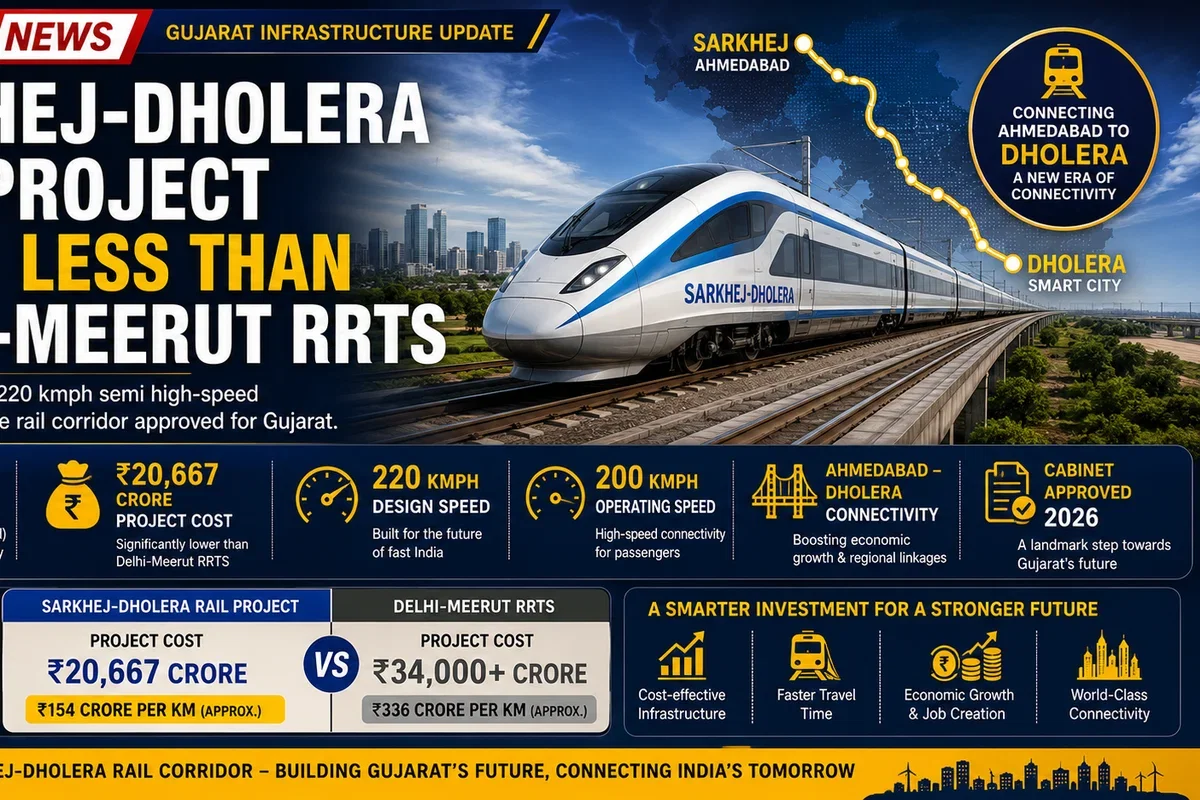

The Sarkhej–Dholera Semi High-Speed Rail Project is a landmark infrastructure initiative approved in May 2026 that aims to connect Ahmedabad (Sarkhej) with Dholera through a 134-km double-line broad-gauge corridor. With an investment of ₹20,667 crore, it will become India's first dedicated semi high-speed rail corridor on broad-gauge tracks, operating at 200 kmph with a design speed of 220 kmph.
The project stands out because its estimated cost of ₹154.2 crore per km is less than half that of the Delhi–Meerut Regional Rapid Transit System (Namo Bharat) (₹336 crore per km) despite offering higher speeds. Lower costs are attributed to tunnel-free construction, reduced land acquisition expenses, broad-gauge compatibility, and the use of India's indigenous Kavach train protection system.
The Sarkhej–Dholera Semi High-Speed Rail Project, expected to cost far less than the Delhi–Meerut RRTS, is set to significantly enhance regional connectivity by improving access to Dholera, strengthening airport connectivity, and boosting overall mobility across the region.
Note: The project is also expected to play a key role in driving economic development in surrounding areas, with completion targeted for 2030–31.
A. What Is the Sarkhej-Dholera Semi High-Speed Rail Project?
The Ahmedabad (Sarkhej) – Dholera Semi High-Speed Rail Project Approved by the Union Cabinet in May 2026, which is a 134-km broad-gauge rail corridor. With a project cost of ₹20,667 crore and an operational speed of 200 kmph, it is expected to significantly improve connectivity between Ahmedabad and Dholera SIR, Dholera International Airport, and Lothal while supporting Gujarat's industrial growth.
1. Key Highlights About the Sarkhej-Dholera Rail Corridor
Parameter | Detail |
|---|---|
Project Name | Sarkhej–Dholera Semi High-Speed Double Line |
Approved By | Cabinet Committee on Economic Affairs (CCEA) |
Total Cost | ₹20,667 crore |
Cost Per km | ~₹154.2 crore |
Total Length | 134 km |
Design Speed | 220 kmph |
Operational Speed | 200 kmph |
Track Type | 1676 mm broad gauge (double line) |
Expected Completion | 2030–31 |
Key Technology | Indigenous Kavach train protection system |
The corridor will become Indian Railways' first semi high-speed route on broad gauge tracks - a stepping stone, as officials have described it, for the phased expansion of semi high-speed rail across the country. It falls under the PM Gati Shakti National Master Plan, India's integrated multi-modal infrastructure programme.
2. Which Areas Will the Sarkhej-Dholera Rail Corridor Connect?
The 134-km double-line corridor runs from Sarkhej (Ahmedabad) to Dholera, passing through and connecting a range of destinations along its alignment.
According to official statements, the corridor will connect Ahmedabad (Sarkhej) with Dholera while improving access to the upcoming Dholera International Airport project and the Lothal National Maritime Heritage Complex (NHMC). The project is also expected to benefit approximately 284 villages and around 5 lakh residents. an engineering profile that reflects the terrain demands of a corridor built for high-speed operation.
Project features 3 Mega Bridges, 74 km of viaduct, 39 road underbridges, and 2 Rail-over-Rail Bridges.
B. Why the Project Costs Less Than the Delhi-Meerut RRTS
According to railway officials, the Sarkhej-Dholera corridor is estimated to cost about ₹154 crore per kilometre, significantly lower than the Delhi-Meerut RRTS. Lower land acquisition costs, the absence of tunnels, and the use of indigenous railway technology contribute to the lower project expenditure.
1. How Does the Sarkhej-Dholera Rail Cost Compare With Delhi-Meerut RRTS?
The Sarkhej-Dholera corridor offers a higher design speed of 220 kmph while costing less per kilometre than the Delhi-Meerut RRTS, making it one of India's most cost-efficient semi high-speed rail projects. The cost advantage of the Sarkhej-Dholera corridor over the Delhi-Meerut RRTS is not marginal - it is structural.
Railway officials quoted in a PTI report laid out the numbers directly:
Project | Cost Per km | Design Speed |
|---|---|---|
Sarkhej–Dholera Semi High-Speed Corridor | ₹154 crore | 220 kmph |
Delhi-Meerut RRTS (Namo Bharat) | ₹336 crore | 180 kmph |
₹358 crore | 320 kmph | |
Standard broad gauge line (up to 160 kmph) | ₹50 crore | 160 kmph |
The Sarkhej-Dholera corridor costs less than half of the Delhi-Meerut RRTS per kilometre while offering a higher design speed of 220 kmph versus the RRTS's 180 kmph.
As one railway official put it: the Gujarat corridor "costs less than half of the Delhi-Meerut RRTS despite offering higher speed capability."
2. Why Is the Sarkhej-Dholera Rail Project More Cost-Efficient?
The project's lower cost is attributed to a tunnel-free alignment, reduced land acquisition expenses, broad-gauge compatibility, and the adoption of India's indigenous Kavach signaling technology.
Railway officials identified primary reasons behind the reduced project expenditure:
1. No tunnels required: The Delhi-Meerut RRTS passes through dense urban areas including underground sections in Delhi, requiring expensive tunnelling. The Sarkhej-Dholera corridor does not require any tunnels. The project features 3 Mega Bridges, Nearly 71 to 74 km of the corridor on viaducts - elevated but far less expensive than underground.
2. Indigenous Kavach train protection system: The Delhi-Meerut RRTS uses the European Train Control System (ETCS) Level-II technology, which costs approximately ₹17.74 crore per Km for signalling alone. The Sarkhej-Dholera corridor uses India's own Kavach automatic train protection system, which costs approximately ₹4.53 crore per kilometer - a saving of over ₹13 crore per kilometer on signalling infrastructure alone.
3. Lower land acquisition costs: The corridor passes through less densely developed land compared to the NCR urban belt, reducing one of the most variable and unpredictable cost components in Indian rail infrastructure projects.
4. Broad gauge compatibility: Unlike the Delhi-Meerut RRTS and the Mumbai-Ahmedabad bullet train, which use standard gauge technology, the Sarkhej-Dholera corridor operates on India's conventional 1676 mm broad gauge network. This eliminates the need for entirely separate gauge infrastructure and allows integration with the existing Indian Railways ecosystem.
C. What Are the Benefits of the Sarkhej-Dholera Rail Corridor?
The rail corridor is expected to reduce travel time between Ahmedabad and Dholera, improve regional mobility, strengthen industrial connectivity, and support the long-term development of Dholera Special Investment Region (Dholera SIR).
1. How Will the Rail Corridor Reduce Travel Time Between Ahmedabad and Dholera?
Operating at up to 200 kmph, the corridor will significantly reduce travel time between Ahmedabad and Dholera, making daily commuting and business travel more efficient.
The corridor's operational speed of 200 kmph will dramatically reduce travel time between Ahmedabad and Dholera - a distance of approximately 100 km that currently requires around two hours by road. At operational speed, the rail journey is expected to take a fraction of that time, fundamentally changing how workers, businesses, and visitors access the Dholera SIR.
For a region whose industrial growth depends on the efficient daily movement of people and goods, this is not a convenience upgrade. It is an economic enabler.
2. How Will the Rail Project Support Dholera Smart City Development?
The rail project will provide faster access to Dholera SIR and strengthen links between the smart city, Ahmedabad, the airport, and surrounding economic zones.
The corridor is explicitly designed to serve India's first greenfield smart city under the Delhi-Mumbai Industrial Corridor (DMIC).
Its key objective, as stated in official documents, is to "enhance multi-modal connectivity and logistic efficiency and to boost the development of Dholera Special Investment Region."
The rail link connects Dholera SIR to Ahmedabad's existing urban and transport infrastructure, effectively solving the last-mile connectivity challenge that has historically slowed industrial uptake in greenfield zones located away from established city centres.
D. How Will the Rail Corridor Impact Dholera's Infrastructure and Economy?
The corridor is expected to become a major transportation backbone for Dholera's future growth by integrating rail, airport, industrial, and logistics infrastructure into a connected economic ecosystem.
1. How Will the Project Support Industrial Growth in Dholera SIR?
The Sarkhej–Dholera Semi High-Speed Rail Corridor is a key part of the PM Gati Shakti National Master Plan, aimed at integrating rail, road, airport, and logistics infrastructure to improve connectivity and reduce transport costs. By linking Ahmedabad with Dholera, it strengthens the transport backbone needed for large-scale industrial growth. The corridor supports manufacturing, logistics, and business expansion across Dholera SIR by improving mobility and attracting investment.
It complements major projects like the Dholera International Airport, industrial zones, and logistics facilities, enhancing regional accessibility. It will also benefit around 284 villages and nearly 5 lakh residents by improving access to employment, education, healthcare, and business opportunities, driving balanced regional development.
2. How Will the Rail Corridor Improve Access to Dholera International Airport?
Direct rail connectivity to Dholera International Airport will improve passenger movement and strengthen multimodal transport links across the region. The combination of a semi high-speed rail corridor and an international airport will create a strong multimodal transport network connecting Ahmedabad, Dholera SIR, and key economic destinations across the region.
Improved airport access is expected to benefit businesses, investors, and travellers by reducing travel times and strengthening regional connectivity. The corridor will also provide direct access to the Lothal Heritage Complex, supporting tourism and enhancing the overall accessibility of major development projects in the Dholera region.
Together, the rail corridor, airport, industrial infrastructure, and logistics network are expected to play an important role in supporting Dholera's long-term vision as a major manufacturing, investment, and economic hub in western India.
E. What Happens Next?
Following Cabinet approval, the project will move through engineering design, land acquisition, environmental clearances, construction, signalling installation, and operational testing before becoming operational.
1. What Are the Next Steps After Cabinet Approval?
The next phase focuses on detailed project planning, tendering, engineering surveys, and obtaining the necessary statutory approvals for construction.
The CCEA approval on 13 May 2026 is the formal green light for the project. The next stages involve detailed engineering surveys, land acquisition proceedings under the relevant legal framework, environmental clearances, and tendering for civil construction contracts. Given that 74 km of the corridor runs on viaduct and includes 3 Mega Bridges, the structural engineering design phase will be substantial.
The indigenous Kavach system's integration also requires detailed signalling design work in coordination with Indian Railways Research Designs and Standards Organisation(RDSO), which governs Kavach's deployment standards across the network.
2. When Will the Sarkhej-Dholera Rail Corridor Be Completed?
The corridor is targeted for completion by 2030–31, with construction and system integration expected to take approximately four to five years.
This timeline encompasses:
Land acquisition and environmental clearances
Civil construction (viaducts, bridges, road underbridges)
Track laying on 1676 mm broad gauge
Kavach system installation and testing
Station construction and finishing
Operational trials and regulatory certification before launch
As India's first semi high-speed broad gauge corridor, the project will also serve as a template for future semi high-speed expansion across Indian Railways - making its execution timeline and cost discipline of national significance beyond Gujarat alone.
F. Key Facts About the Sarkhej-Dholera Semi High-Speed Rail Project
The Sarkhej-Dholera Rail Project combines higher speeds, lower construction costs, and strategic connectivity. It is expected to strengthen Dholera SIR's accessibility while serving as a model for future semi high-speed rail development in India.
The Sarkhej-Dholera Semi High-Speed Rail Project makes a case that is hard to argue with: higher speed does not have to mean proportionally higher cost. At ₹154.2 crore per km versus ₹336 crore for the Delhi-Meerut RRTS, the project demonstrates what is achievable when tunnel requirements are eliminated, indigenous signalling technology replaces imported systems, and broad gauge compatibility removes the need for separate infrastructure.
Five facts that define this project:
₹20,667 crore total cost - approved by CCEA on 13 May 2026
220 kmph design speed, 200 kmph operational speed - faster than the Delhi-Meerut RRTS's 180 kmph
₹154 crore per km - less than half the Delhi-Meerut RRTS's ₹336 crore per km
Kavach signalling at ₹4.53 crore/km vs. ETCS Level-II at ₹17.74 crore/km on the RRTS
Completion targeted by 2030–31 - with connectivity to Dholera SIR, Dholera Airport, and Lothal NHMC
Sarkhej-Dholera Rail Project at a Glance :
Metric | Value |
Length | 134 km |
Cost | ₹20,667 crore |
Cost per km | ₹154.2 crore |
Design Speed | 220 kmph |
Operational Speed | 200 kmph |
Completion Target | 2030–31 |
Technology | Kavach |
Villages Benefited | 284 |
Population Impact | 5 lakh |
Airport Connectivity | Dholera International Airport |
FAQ About the Sarkhej-Dholera Rail Project
1. What is the Sarkhej-Dholera Semi High-Speed Rail Project?
It is a 134-km double-line semi high-speed rail corridor connecting Ahmedabad (Sarkhej) to Dholera, approved by the CCEA on 13 May 2026 at a total cost of ₹20,667 crore. It will be Indian Railways' first semi high-speed corridor on broad gauge tracks, with a design speed of 220 kmph and an operational speed of 200 kmph.
2. Why does the Sarkhej-Dholera corridor cost less than the Delhi-Meerut RRTS?
Three main factors: no tunnels required (the Delhi-Meerut RRTS needs underground sections), use of India's indigenous Kavach signalling system (₹4.53 crore/km vs. ₹17.74 crore/km for ETCS Level-II used in Delhi-Meerut), and lower land acquisition costs along the Gujarat alignment.
3. How does the cost per km compare between the two projects?
The Sarkhej-Dholera corridor costs approximately ₹154 crore per km. The Delhi-Meerut RRTS costs approximately ₹336 crore per km - more than double - despite having a lower design speed of 180 kmph versus 220 kmph for the Gujarat corridor.
4. What is the Kavach train protection system?
Kavach is India's indigenous automatic train protection system developed by RDSO. It is designed to prevent train collisions by automatically applying brakes when signals are violated. The project will use the indigenous Kavach train protection system, which officials say is significantly cheaper than imported ETCS-based signalling systems
5. When will the Sarkhej-Dholera rail corridor be completed?
The project is targeted for completion by 2030–31, approximately four to five years from the CCEA approval in May 2026.
6. Which destinations does the corridor connect?
The corridor provides direct connectivity between Ahmedabad, the Dholera Special Investment Region (SIR), the upcoming Dholera International Airport, and the Lothal National Maritime Heritage Complex (NHMC). It will also enhance connectivity to approximately 284 villages with a combined population of around 5 lakh people