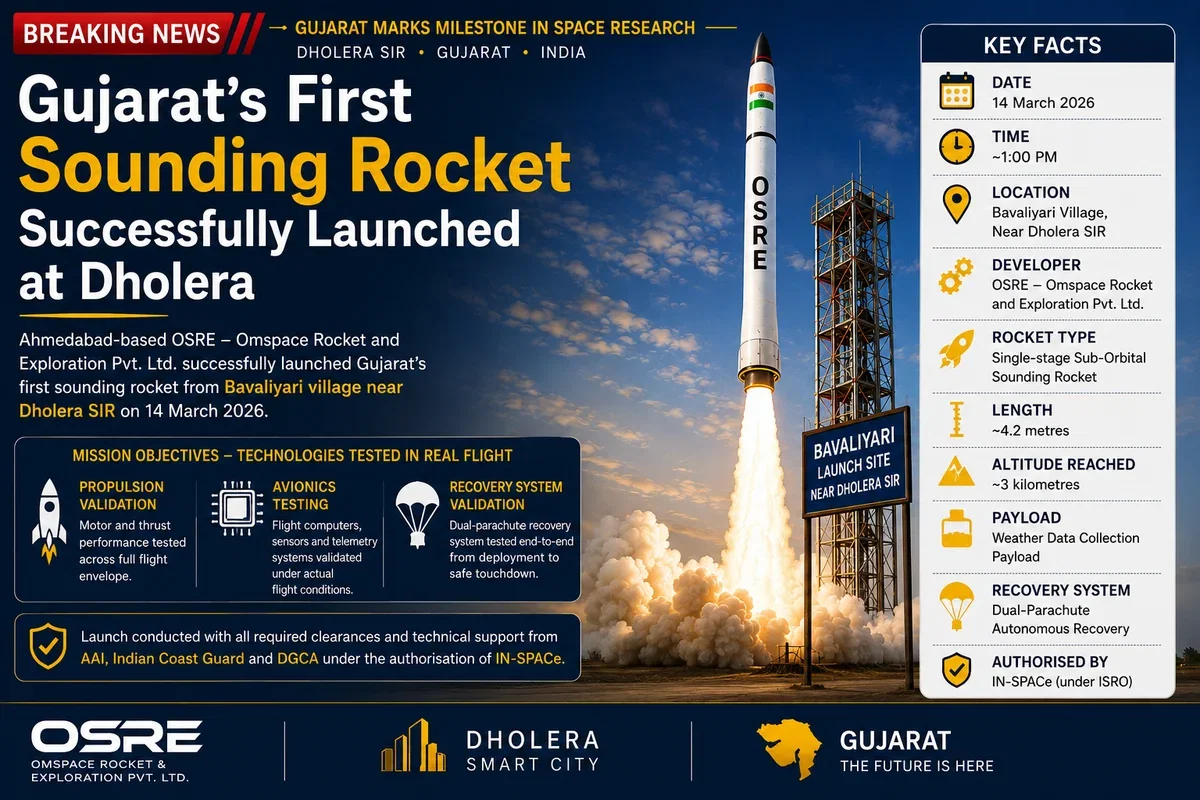

Gujarat marked a significant milestone in India's private space journey when Ahmedabad-based Omspace Rocket and Exploration Private Limited (OSRE) successfully launched the state's first private sounding rocket from Bavaliyari village near Dholera Special Investment Region (SIR) on 14 March 2026. Conducted under the authorisation of Indian National Space Promotion and Authorisation Centre (IN-SPACe) and supported by agencies including DGCA, AAI, and the Indian Coast Guard, the mission demonstrated Gujarat's emerging capabilities in aerospace innovation and rocket development.
The single-stage sub-orbital sounding rocket, built entirely in Ahmedabad using carbon fibre and advanced composite materials, reached an altitude of approximately 3 kilometres before safely returning to Earth using a dual-parachute autonomous recovery system. The mission successfully validated three critical systems: propulsion, avionics, and recovery technologies under real flight conditions.
Beyond the technical achievement, the launch represents Gujarat's formal entry into India's growing private spacetech ecosystem. It highlights the state's ability to support end-to-end aerospace activities, from design and manufacturing to launch operations and system recovery. The success also aligns with the Gujarat Spacetech Policy 2025–2030, which aims to encourage startups, indigenous innovation, and advanced research within the state.
For OSRE, the mission provides valuable flight heritage and serves as an important stepping stone toward its future goal of developing "Infinity One," a proposed fully indigenous reusable launch vehicle. For Gujarat, the launch establishes Dholera as a potential hub for aerospace testing and strengthens India's expanding network of private space innovators.
A. First Private Sounding Rocket Flight Validates Systems in Gujarat
Gujarat’s first sounding rocket launch at Dholera marks a major space research milestone for the state. This achievement demonstrates Gujarat’s first successful private rocket launch, validating key systems such as propulsion, avionics, and recovery. It further establishes end-to-end sub-orbital testing capability under real flight conditions, confirming practical rocket development capacity in Gujarat.
1. Technical Overview and Mission Specifications
The launch took place at approximately 1:00 PM on 14 March 2026 from a temporary launch complex set up at Bavaliyari near Dholera in the Dholera Special Investment Region (SIR).
The rocket was a single-stage sub-orbital sounding rocket, measuring approximately 4.2 metres in length, built using carbon fibre and advanced composite materials at Omspace's laboratory in Ahmedabad - a full Make in India construction from airframe to avionics.
📋 Mission Snapshot
Parameter | Detail |
|---|---|
Launch Date | 14 March 2026 |
Launch Time | ~1:00 PM |
Launch Site | Bavaliyari, near Dholera SIR |
Developer | OSRE (Ahmedabad) |
Rocket Type | Single-stage Sub-orbital Sounding Rocket |
Rocket Length | ~4.2 metres |
Altitude Reached | ~3 Km |
Recovery System | Dual-parachute Autonomous Recovery |
Payload | Weather Data Instrument |
Materials | Carbon Fibre And Advanced Composite |
Authorisation Body | IN-SPACe (under ISRO) |
The rocket successfully ascended, reached its target altitude, and was recovered safely along its predicted trajectory. The rocket reached an altitude of approximately 3 kilometres and executed a successful landing using a dual-parachute recovery system, touching down safely along its predicted path. Minister Arjun Modhwadia, MLA Kalubhai Dabhi, and officials from the Department of Science and Technology were present at the launch site.
The launch was conducted after receiving all required clearances and technical support from the Airports Authority of India (AAI), the Indian Coast Guard, and the Directorate General of Civil Aviation (DGCA). The mission was carried out under the formal authorisation of IN-SPACe - the Indian National Space Promotion and Authorisation Centre operating under ISRO.
This launch is best understood as a systems validation flight rather than a space mission. The achievement confirms:
End-to-end rocket integration capability in Gujarat
Functional coordination between private aerospace startup and national regulators
Viability of temporary launch infrastructure for sub-orbital testing
At a technical level, this corresponds to an early technology readiness validation milestone, where multiple subsystems are proven in real flight conditions.
2. Objectives of the Sounding Rocket Mission
The mission was designed to test multiple advanced technologies in real flight conditions - systems that cannot be fully validated on the ground.
Three primary systems were evaluated:
1. Propulsion: The rocket's motor and thrust performance were tested across the full flight envelope from ignition to burnout, confirming that the propulsion system performs as designed at sub-orbital altitudes.
2. Avionics: The onboard electronics - including flight computers, sensors, and telemetry systems - were evaluated under actual flight loads, vibration, and thermal conditions, verifying that data transmission and flight control functions operate correctly in the field.
3. Autonomous recovery system: The dual-parachute recovery mechanism - a critical system for any reusable or recoverable rocket - was tested end-to-end, from deployment trigger to safe touchdown. Its successful operation confirmed that OSRE's recovery architecture works under live conditions.
This mission follows a standard aerospace development pattern where:
Ground testing is insufficient for full validation
Real atmospheric flight is required to expose system behavior
Recovery systems are tested early to reduce future reusability risk
Essentially, this is a hardware-in-the-loop validation executed in real atmospheric conditions, which is a critical step before any orbital-class development.
B. Why This Marks Gujarat’s Entry into Private Space Technology
It establishes Gujarat’s formal entry into active rocket experimentation and early aerospace manufacturing. The success signals the beginning of a local space technology ecosystem and strengthens India’s private space landscape.
1. Gujarat’s Emerging Aerospace Capability
Before 14 March 2026, Gujarat had no record of a rocket launch on its soil. That changed with a single flight from a temporary pad at Bavaliyari. As OSRE Founder and CEO Dr. Ravindra Raj stated after the launch, the success would help pave the way for the development of India's first fully indigenous Reusable Launch Vehicle Technology , Infinity One - OSRE's next declared programme milestone.
The fact that the rocket's airframe was built in Ahmedabad using carbon fibre and composite materials - not imported, not assembled from overseas components - establishes that Gujarat now has a functioning, if early-stage, advanced aerospace manufacturing capability. The materials used are the same class employed in commercial and research rockets globally. Building with them locally, for a rocket that actually flew, is an engineering statement.
Minister Modhwadia framed the significance directly:
"This achievement shows that Gujarat is ready to play a significant role in India's expanding space ecosystem."
2. Significance for India's Growing Space Ecosystem
India's private space sector reforms have historically been concentrated around Bengaluru and Sriharikota - the locations of ISRO's primary facilities and the ecosystem of suppliers and talent that grew around them. The Dholera launch signals something different: that space innovation beyond traditional hubs is now a reality, not a roadmap item.
The mission was formally authorised by IN-SPACe, the regulatory and promotional body established in 2020 to open India's space sector to private players alongside ISRO. OSRE becoming the first private entity to fly a rocket developed on Gujarat's soil - under IN-SPACe authorisation , with DGCA, AAI, and Indian Coast Guard maritime coordination & clearances - demonstrates that the regulatory pathway for private launches outside established space corridors is functional and accessible to well-prepared startups.
For India's broader space ambitions, every geographic node that enters the private launch ecosystem strengthens the network's resilience and competitive depth.
C. Dholera’s Role as an Emerging Aerospace Test Zone
Dholera is evolving into a low-risk aerospace testing zone due to its open terrain, low population density, and suitable airspace conditions. It supports temporary launch operations for early-stage rocket development and real-world validation.
1. Strategic Importance of the Launch Site
The choice of Bavaliyari near Dholera for Gujarat's first rocket launch was not incidental. The Dholera Special Investment Region offers flat, low-density land with clear airspace - physical requirements that a launch site cannot negotiate around. The temporary launch complex set up at Bavaliyari demonstrated that the area can support aerospace test operations without dedicated permanent infrastructure, which is a significant characteristic for a startup operating within constrained budgets.
For Dholera SIR, the launch adds a new category to the region's industrial and innovation identity. The SIR has been built around manufacturing, logistics, and smart city infrastructure. A rocket launch from within its boundaries signals that advanced research and experimental aerospace activities are also finding a home here.
2. Alignment with Smart City and Spacetech Policy Goals
The Dholera SIR is designed as India's first greenfield smart city - a planned urban and industrial zone built from the ground up with 21st-century infrastructure and sector diversity. The inclusion of aerospace experimentation within that landscape aligns directly with the smart city's vision of hosting high-technology, knowledge-intensive activities alongside manufacturing and logistics.
Minister Modhwadia cited the policy directly in his post-launch statement: "Through the Gujarat Spacetech Policy 2025–2030, we are encouraging startups and young innovators to develop indigenous space technologies."
D. Impact on Gujarat’s Space Innovation and Startup Ecosystem
The mission creates a complete local aerospace workflow from design and manufacturing to launch and recovery. This strengthens startups, research capability, and the broader space technology supply chain in Gujarat.
1. Local Aerospace Development and Supply Chain Growth
OSRE's successful launch validates a complete aerospace development pipeline - from materials sourcing and airframe construction in Ahmedabad, through propulsion and avionics development, to a licensed and coordinated multi-agency launch at a field site. That pipeline now exists in Gujarat, with a proven flight record behind it.
Dr. Ravindra Raj's stated next objective - the development of Infinity One, India's first fully indigenous reusable launch vehicle - places OSRE in a significantly stronger position post-flight. Investors, institutional partners, and government programme managers evaluate aerospace startups in large part on demonstrated flight heritage. A successful sub-orbital launch, with system validations across propulsion, avionics, and recovery, is exactly that heritage.
The broader opportunity for Gujarat's aerospace sector is supply chain development. A functioning rocket startup anchored in Ahmedabad creates demand for specialised materials, precision machining, electronics, testing services, and software - all of which can be sourced locally as the ecosystem matures.
2. Potential Benefits for Education and Startups
The OSRE team - described by Minister Modhwadia as "young scientists" - represents the profile of talent that Gujarat's aerospace ecosystem needs to grow. A successful public launch, witnessed by a state minister and covered nationally, has a demonstrable effect on the ambition of engineering students and early-stage innovators across the state.
OSRE has also established a 30,000 sq. ft. Space Tech Centre in Ahmedabad, which serves as its primary development and manufacturing facility. A facility of that scale, producing rocket hardware that actually reaches altitude, is a tangible anchor around which the state's space startup community can develop.
E. Future of Space Technology Development in Dholera
The next phase focuses on reusable launch vehicle development and more advanced flight systems beyond sub-orbital testing. This transition will move the ecosystem toward scalable and commercially viable space technologies.
1. Future Research and Testing Plans
The immediate next milestone declared by OSRE is the development of Infinity One - described as India's first fully indigenous reusable launch vehicle. A reusable vehicle is a substantially more complex engineering challenge than a sounding rocket: it requires the rocket to survive re-entry, navigate controlled descent, and land for refurbishment and reuse. The successful dual-parachute recovery system tested in the Dholera mission is an early but directly relevant stepping stone toward that goal.
The atmospheric and weather payloads used in sounding rockets carried in the Bavaliyari mission also opens the door to scientific collaborations - with meteorological agencies, universities, or atmospheric research institutions - that could generate recurring demand for sub-orbital flight services from the region.
2. Long-Term Aerospace Cluster Development in Gujarat
The Gujarat Spacetech Policy 2025–2030 provides the institutional framework within which Dholera's aerospace future will be shaped. The policy's explicit goals - encouraging startups, satellite innovation, and aerospace research - create a five-year window during which the groundwork laid by OSRE's first launch can be built into a functioning regional aerospace cluster.
For Dholera specifically, the combination of available land, clear airspace, growing infrastructure, and proximity to Ahmedabad's engineering talent base makes it a credible long-term location for aerospace testing and research activities. The Bavaliyari launch demonstrated all of these advantages working together in practice - not in theory.
Key Technical and Strategic Takeaways
Gujarat's first sounding rocket launch from Bavaliyari near Dholera on 14 March 2026 is a milestone with implications that extend well beyond a single flight:
OSRE became the first private entity to fly a rocket built on Gujarat's soil - under full IN-SPACe, DGCA, AAI, and Coast Guard authorisation
The single-stage sub-orbital rocket reached ~3 km altitude and returned safely via a dual-parachute autonomous recovery system
Three core systems were validated in flight: propulsion, avionics, and autonomous recovery
The rocket was built in Ahmedabad using carbon fibre and advanced composite materials - a fully indigenous Make in India construction
The Gujarat Spacetech Policy 2025–2030 and IN-SPACe authorisation framework together provide the regulatory and policy infrastructure for this activity to grow
Infinity One - OSRE's next declared programme, India's first proposed fully indigenous reusable launch vehicle - now has a proven flight team behind it
Frequently Asked Questions
1. Who launched the first private sounding rocket in Gujarat?
The rocket was developed and launched by Omspace Rocket and Exploration Private Limited (OSRE), an Ahmedabad-based private space technology startup. The launch was conducted under the authorisation of IN-SPACe (under ISRO), with clearances from AAI, DGCA, and the Indian Coast Guard.
2. When and where was Gujarat's first sounding rocket launched?
The launch took place on 14 March 2026 at approximately 1:00 PM from a temporary launch complex at Bavaliyari village near Dholera in the Dholera Special Investment Region (SIR), Gujarat.
3. What altitude did the rocket reach?
The single-stage sub-orbital sounding rocket reached an altitude of approximately 3 kilometres.
4. What systems were tested during the mission?
The mission validated three primary systems: propulsion, avionics, and an autonomous dual-parachute recovery system. A small weather data collection payload was also carried onboard.
5. What materials was the rocket made from?
The rocket's airframe was constructed using carbon fibre and advanced composite materials at OSRE's laboratory in Ahmedabad - a fully Make in India build.
6. What is Infinity One?
Infinity One is OSRE's next declared development programme - described as India's first fully indigenous reusable launch vehicle. OSRE's Founder and CEO, Dr Ravindra Raj stated the Dholera launch success would help pave the way toward Infinity One's development.
7. What is the Gujarat Spacetech Policy 2025–2030?
It is the Gujarat state government's policy framework designed to encourage space startups, satellite innovation, and aerospace research within the state. Minister Arjun Modhwadia cited it as the policy backbone behind the state's support for OSRE's mission.