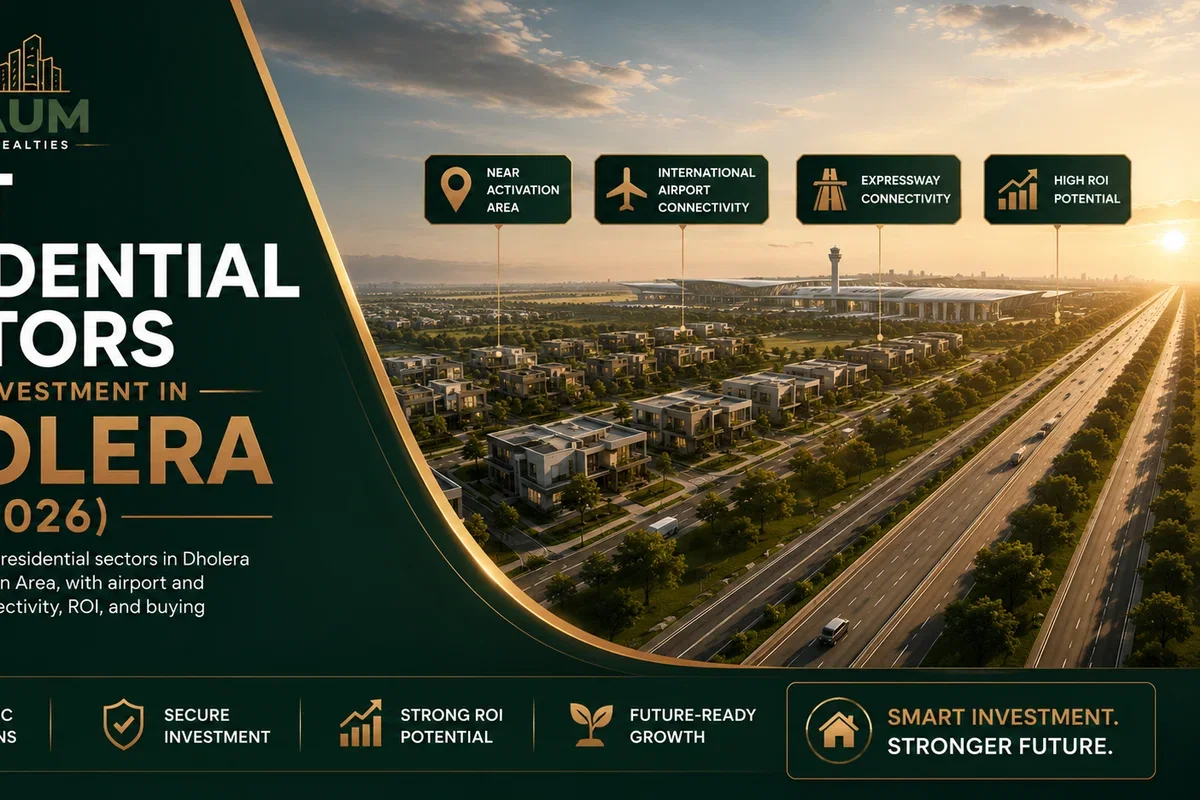
The best residential sectors in Dholera currently include TP1 and TP2, especially locations around the Activation Area, as they offer a strong combination of developed infrastructure, industrial connectivity, and lower development risk. Meanwhile, TP3 and TP4 present promising long-term appreciation potential, driven by future growth around the airport corridor and expanding urban development.
The Dholera Special Investment Region is India’s flagship greenfield smart city project, planned under the Delhi–Mumbai Industrial Corridor (DMIC) initiative. It is being developed through the efforts of the Dholera Special Investment Region Development Authority (DSIRDA) and Dholera Industrial City Development Limited (DICDL) . Spread across approximately 920 sq km, Dholera is being developed systematically through Town Planning (TP) Schemes, with trunk infrastructure, industrial investments such as the semiconductor facility by Tata Group, and the Ahmedabad–Dholera Expressway gradually transforming the master plan into a functional urban ecosystem.
For anyone evaluating land investment in Dholera, the key question is not only “Should I invest in Dholera?” but also “Which residential sector in Dholera offers the best potential?” Location within DSIR plays a crucial role. A residential plot situated within or near the Dholera Activation Area, supported by developed roads, water supply, electricity infrastructure, and planned amenities, can have significantly different livability and appreciation prospects compared to a plot located in peripheral areas awaiting future development phases.
In summary, the most attractive residential sectors in Dholera are those located near the Activation Area, Ahmedabad–Dholera Expressway, airport corridor, and approved Town Planning (TP) Schemes. These locations provide the strongest combination of infrastructure readiness, connectivity, and long-term growth potential.
This guide explains how Dholera’s sectors are planned, identifies the zones that may offer opportunities for investors and end-users, and provides a practical approach to evaluating residential plots before making a purchase decision.
Prepared by Aum Realties, a Dholera SIR Real Estate Consultant specializing in Town Planning (TP) Schemes, infrastructure development, and investment opportunities across Dholera. The insights presented in this guide are based on an analysis of government planning documents, infrastructure updates, and on-the-ground market observations.
A. How Dholera's Smart City Layout Helps You Choose the Best Residential Sector
Before comparing residential plots, create a short evaluation checklist covering the TP Scheme, current infrastructure status, road connectivity, surrounding land use, and future government projects. Looking at these factors together provides a more accurate picture than relying on a project's marketing name or advertised location. It helps to understand how Dholera is actually organized on paper because "sector" and "TP Scheme" are often used loosely by developers but mean specific things under Gujarat's planning law.
1. TP Schemes vs Residential Sectors: What's the Difference?
Dholera SIR's developable area is legally divided into six Town Planning Schemes, TP1 through TP6, sanctioned under the Gujarat Town Planning and Urban Development Act, 1976. Each TP Scheme is further broken into land-use blocks: residential, commercial, industrial, mixed-use, and green/recreational zones.
When developers refer to "Sector 1," "Sector 2," or similar, they are usually describing a residential pocket within a specific TP Scheme rather than an official government sector number, so it's worth verifying which TP Scheme a marketed "sector" actually falls under before buying.
When reviewing a project brochure, ask the developer to identify the exact TP Scheme on the approved layout map. This simple verification helps buyers confirm whether the advertised residential location aligns with official planning documents.
Many developers use terms such as "Sector 1", "Sector 2", or "premium sector" as marketing descriptions. Buyers should always verify the actual TP Scheme number, village location, zoning classification, and approved layout before purchasing.
2. How the Dholera Master Plan Is Structured
Development phases also influence construction activity, traffic patterns, and nearby amenities. Buyers planning to build sooner may prefer locations where surrounding infrastructure is already progressing rather than areas scheduled for later expansion.
TP1 and TP2 form Phase 1 of development, together covering roughly 153 sq km, and this is where the bulk of ready infrastructure sits today. TP3 through TP6 represent later phases, closer to the airport corridor and the region's outer boundary, and are expected to activate as Phase 1 matures.
TP Scheme Development Timeline Table:
TP Scheme | Development Phase | Investment Profile |
TP1 | Phase 1 | Industrial employment-driven |
TP2 | Phase 1 | Highest infrastructure readiness |
TP3 | Future expansion | Airport corridor opportunity |
TP4 | Future expansion | Airport + premium residential potential |
TP5 | Later phase | Higher risk, lower entry |
TP6 | Outer expansion | Long-term land banking |
3. Residential vs Industrial vs Mixed-Use Zones in Dholera
Besides checking zoning, review adjacent land parcels to understand how the surrounding neighborhood may evolve. Nearby commercial or institutional developments can improve convenience without significantly affecting residential comfort.
Within each TP Scheme, DSIRDA allotted land for distinct purposes: industrial clusters (like the semiconductor and electronics zone anchored by Tata), knowledge and IT precincts, residential townships, and civic/institutional land. Residential zoning tends to cluster near planned social infrastructure and away from heavy-industry blocks, which matters for both livability and long-term resale appeal.
4. Why the Dholera Activation Area Matters Most for Residential Investment
Rather than focusing only on distance from the Activation Area, compare whether a property enjoys direct access to completed roads and utility corridors. Nearby connectivity often matters more than simple geographic proximity.
The single most important planning concept for a homebuyer or investor is the Activation Area, a roughly 22.5 sq km zone spread across TP2 (West) and TP4 where the government has concentrated trunk infrastructure first. This area has around 72 km of internal roads (ranging from 12m to 70m wide), along with power, water, drainage, and fiber connectivity largely in place.
The demonstration zone is meant to prove Dholera's model works before the rest of the SIR is built out, which is why residential plots inside or adjacent to it carry a real infrastructure premium over land in Future Development Areas that are still awaiting basic services.
5. How Infrastructure Drives Residential Property Values in Dholera
Investors should evaluate visible on-the-ground development during site visits, including road quality, utility connections, and surrounding construction activity. Physical progress often provides better insight than promotional material.
In any greenfield city, land value tracks infrastructure completion, not just master-plan promises. Roads, utilities, and an operating administrative hub (Dholera's ABCD Building, the Administrative and Business Centre for Dholera, houses DSIRDA and DICDL offices in TP2 West) are tangible signals that a zone is investment-ready rather than speculative. Sectors that already have this in place are structurally positioned to appreciate sooner than sectors that don't.
B. How to Choose the Best Residential Sector in Dholera
Every buyer prioritizes different objectives. Long-term investors may focus on appreciation potential, while end users often benefit more from sectors that balance connectivity, convenience, and future neighborhood development. Not every plot inside DSIR's boundary is equally desirable. These are the factors that consistently separate strong residential sectors from weaker ones.
1. Connectivity to the Ahmedabad–Dholera Expressway and Dholera International Airport
Consider everyday accessibility in addition to regional connectivity. Easy movement between residential areas, commercial zones, and employment centres can significantly improve long-term livability.
The Ahmedabad–Dholera Expressway, a 109 km, four-lane access-controlled highway expandable to eight lanes, is the backbone connecting Dholera to Ahmedabad, cutting travel time to roughly 45 minutes once fully operational. Sectors with direct or near-direct access to this expressway and proximity to the upcoming Dholera International Airport near Navagam generally command a connectivity premium.
2. How to Evaluate Infrastructure Readiness Before Buying
If possible, visit the site to verify completed infrastructure instead of relying solely on brochures or digital maps. Seeing roads, drainage systems, and utility installations firsthand can provide additional confidence.
Look for sectors with completed roads, water supply, drainage, power, and ICT/fiber networks rather than those still shown only on planning maps. The Activation Area is the clearest example of "ready" infrastructure inside DSIR today.
3. Social Infrastructure for Families
Community facilities often become stronger indicators of residential maturity as a city develops. Areas planned around schools, healthcare, and public amenities generally attract more stable long-term residents.
Schools, healthcare facilities, and community amenities are being developed in phases alongside the Activation Area. Sectors closer to these planned civic clusters are naturally more attractive for end-use buyers and families, not just investors.
4. Employment, Commercial Hubs, and Residential Demand
Access to everyday shopping, banking, and essential services contributes to residential convenience and may support stronger demand from future occupants. Residential sectors near the Knowledge and IT Zone, the ABCD Building precinct, and industrial clusters benefit from proximity to future jobs, a key driver of rental demand and owner-occupancy once the city matures.
5. Future Employment Corridors and Industrial Demand
Employment growth typically creates demand across housing, retail, and community services. Residential sectors positioned to serve this expanding workforce may experience broader market activity over time.
Major anchor investments, including Tata's semiconductor facility, ReNew Power's solar manufacturing plant, and logistics/petroleum players, are concentrated around TP1 and TP2. Residential land within a reasonable commute of these employment corridors is likely to see earlier housing demand than land far from any industrial anchor.
6. Why Government Development Priorities Affect Property Appreciation
Monitoring official infrastructure announcements periodically allows buyers to understand whether development is progressing according to planned priorities before making additional investments.
DSIRDA's own prioritization, visible through which TP Schemes have finalized layouts, NA (Non-Agricultural) conversions, and infrastructure contracts already awarded, is one of the most reliable indicators of where growth will land first.
C. Best Residential Sectors in Dholera Compared (TP1–TP6)
Comparing residential sectors becomes easier when each location is assessed using the same criteria, such as infrastructure readiness, accessibility, future employment, and surrounding development, rather than price alone.
Quick Comparison of the Best Residential Sectors in Dholera:
TP Scheme | Best For | Current Advantage | Future Growth Driver | Risk |
TP1 | Investors | Industrial proximity | Manufacturing jobs | Low-Medium |
TP2 | Investors + families | Activation Area | Commercial growth | Low |
TP3 | Airport investors | Airport corridor | Aviation economy | Medium |
TP4 | Long-term premium buyers | Airport + expansion | Urban development | Medium |
TP5 | Speculative investors | Lower entry price | Future infrastructure | High |
TP6 | Budget investors | Long holding period | Outer expansion | High |
1. Sectors Near the Activation Area (Core Growth Zone)
These locations may appeal to buyers seeking a balance between infrastructure certainty and future appreciation, making them suitable for investors who prefer relatively lower development risk.
Residential pockets within or immediately bordering the Dholera Activation Area (TP2 West and TP4) benefit most directly from completed roads and utilities, proximity to the ABCD Building administrative hub, and the presence of anchor industries already operating or under construction nearby. This is generally considered the core growth zone for near-term investment.
2. Why TP1 Is One of the Best Residential Areas in Dholera
Buyers considering TP1 should compare multiple residential pockets within the scheme rather than assuming all locations offer identical advantages. TP1, covering roughly 51 sq km, is part of Phase 1 and sits close to the industrial base of DSIR. Residential zones here are positioned to benefit as industrial employment scales up, though buyers should confirm which specific blocks are designated residential versus industrial before purchasing.
3. Residential Sectors Near Dholera International Airport
Airport-oriented locations may be better suited to buyers with longer investment horizons who are comfortable waiting for supporting commercial and residential demand to mature. Sectors within TP3 and TP4, closer to the planned Dholera International Airport, are considered longer-horizon plays.
Once airport operations begin, these corridors are expected to see accelerated demand from logistics, aviation-linked employment, and hospitality, but because airport construction timelines have shifted before, this remains a higher-patience investment compared to Activation Area sectors.
4. Mixed-Use Township Sectors With High Demand
Integrated developments often encourage a more balanced urban environment by reducing dependence on long-distance travel for everyday needs. Some residential development is being planned as part of larger mixed-use townships that combine housing with retail, institutional, and recreational land use. These sectors tend to appeal to end-users who want walkable access to daily amenities rather than pure land-banking investors.
5. Are TP5 and TP6 Worth Investing In?
Lower entry prices can improve affordability, but investors should balance potential upside with the possibility of longer holding periods before surrounding infrastructure catches up. TP5 and TP6, further from the Activation Area, are earlier in their development curve. Prices here are typically lower, which can suit long-horizon investors comfortable waiting multiple development phases for infrastructure to catch up, but due diligence on layout approval status is especially important in these zones.
6. Investment vs End-Use: Which Residential Sector Should You Choose?
Choosing between investment-focused and end-user locations depends largely on personal objectives, expected holding period, and risk tolerance rather than on any single location outperforming all others.
Sectors near the Activation Area and expressway generally suit investors seeking faster infrastructure-led appreciation, while sectors closer to planned social infrastructure and mixed-use townships suit families planning to eventually live in Dholera. The two goals overlap most cleanly in TP1 and TP2, which is why these schemes attract the widest mix of buyer profiles.
D. Best Residential Areas in Dholera for Families and End Users
Families should evaluate how comfortably a neighborhood can support daily living over several years, including future convenience, mobility, and access to essential services as development progresses. Investors and end-users don't always want the same thing. A family relocating to Dholera cares more about daily livability than pure appreciation curves
1. Access to Schools, Healthcare, and Community Services
Social infrastructure, including school campuses and hospital facilities, is being developed in phases alongside the Activation Area's core buildout. Families should prioritize sectors within easy reach of these planned facilities rather than assuming amenities will follow housing everywhere at the same pace.
2. Green Spaces and Sustainable Urban Living
DSIR's master plan reserves recreational and green-buffer land within each TP Scheme, and the ABCD Building itself is designed as a LEED Gold-certified facility, a signal of the sustainability standards being applied across the city's civic infrastructure.
3. Smart Utilities and Digital Infrastructure
The Activation Area's fiber, SCADA-based utility monitoring, and integrated command-and-control systems mean residential sectors here are being built with genuinely "smart" infrastructure from day one, rather than retrofitted later.
4. Safety, Mobility, and Walkable Neighborhoods
Wide, well-lit internal roads (12m to 70m) and a planned Bus Rapid Transit System for intra-city mobility support safer, more walkable residential layouts than typical unplanned peripheral development.
5. Future Lifestyle Ecosystem for Residents
As commercial, retail, and institutional land uses activate around residential blocks, sectors near the Knowledge and IT Zone and mixed-use townships are likely to offer the most complete day-to-day lifestyle ecosystem first.
E. Which Residential Sectors in Dholera Have the Highest Appreciation Potential?
ROI should be assessed using multiple indicators instead of appreciation alone. Infrastructure completion, housing demand, employment growth, and future occupancy all contribute to long-term investment performance.
1. How Property Prices Have Changed Across TP1–TP6
Land values across DSIR have generally trended upward as infrastructure milestones, expressway progress, industrial land allotments, and utility completion have been achieved, with TP1, TP2, and TP6 reported as leading recent price momentum while TP4 and TP5 have shown recovery after earlier corrections.
2. Why Infrastructure Creates Higher Property Appreciation
The pattern seen in other Indian growth corridors, where land values rose sharply after roads and utilities were completed, not before, is a useful lens for Dholera. This favors sectors with finished infrastructure today over those still awaiting it.
3. Airport and Expressway Influence on Property Values
Expressway completion has historically been one of the strongest catalysts for land appreciation in Indian peripheral development zones, and Dholera's own expressway progress is widely cited by developers as the single biggest driver of recent interest in TP1 and TP2 sectors. Airport completion is expected to have a similar, if delayed, effect on TP3 and TP4.
4. High-Risk vs. High-Growth Locations
Sectors near completed infrastructure carry lower execution risk but may already reflect some of that value in current prices. Peripheral sectors carry higher risk (dependent on future phase timelines) but potentially higher percentage upside if development proceeds on schedule.
5. Long-Term Wealth Creation Opportunities
For most buyers, a blended approach anchoring a portfolio in Activation Area-adjacent sectors while taking a smaller, longer-horizon position in emerging TP Schemes balances near-term infrastructure certainty with longer-term upside.
F. Best Residential Sectors Near Major Infrastructure Projects in Dholera
Major infrastructure projects often influence residential demand gradually rather than immediately. Buyers should consider how supporting commercial and civic development may evolve alongside these projects.
1. Residential Zones Near Dholera International Airport
The planned airport, located near Navagam, is intended to serve as a major cargo and passenger hub with connectivity to the expressway and a proposed rail line. Residential sectors within a reasonable radius stand to benefit once construction and operations reach completion, though buyers should treat airport-linked timelines with some caution given the scale of the project.
2. Sectors Connected to the Ahmedabad–Dholera Expressway
Expressway-facing or expressway-proximate sectors, largely within TP1 and TP2, offer the most direct commuting benefit to Ahmedabad and are typically the most actively marketed residential zones in DSIR today.
3. Residential Sectors Near Tata Semiconductor and Industrial Zones
Proximity to the semiconductor, electronics, and renewable-energy manufacturing clusters means shorter commutes for the skilled workforce these industries will employ, a meaningful factor for both rental yield and end-use demand.
4. Residential Areas Near Proposed Metro and BRTS Corridors
An elevated metro corridor connecting Ahmedabad and Dholera has been proposed alongside intra-city BRTS, both of which, once built, would further favor sectors along these planned alignments.
5. Infrastructure Completion Timelines and Their Impact
Because Dholera is a phased greenfield project, infrastructure completion timelines directly determine when a sector's appreciation potential is actually realized. Buyers should track DSIRDA's official updates rather than relying solely on developer marketing for completion dates.
G. Checklist Before Buying Residential Property in Dholera
Careful due diligence helps buyers avoid unnecessary legal or planning-related issues. Taking time to verify documentation before purchase is generally easier than resolving disputes after ownership. Dholera's scale and long development horizon make due diligence essential, regardless of which sector you're considering.
1. How to Verify Approved Residential Projects
Confirm that a project has completed NA (Non-Agricultural) conversion, holds a valid NOC, and sits within a finalized TP Scheme layout approved by DSIRDA, not just within the broad 920 sq km DSIR boundary.
2. Understanding Government Notifications and Zoning
Cross Check the specific TP Scheme number and land-use designation (residential vs. industrial vs. green buffer) against DSIRDA's official planning documents rather than a developer's sector name alone.
3. Common Mistakes First-Time Investors Make
The most frequent mistakes are buying land several kilometers outside the SIR boundary marketed loosely as "Dholera," skipping title and NA-NOC verification, and assuming all TP Schemes will develop on the same timeline as TP1 and TP2.
4. Evaluating Developers and Land Documentation
Work only with developers who can produce clear title documents, DSIRDA-recognized layout approvals, and, where applicable, RERA registration for the specific project.
5. Residential Plot Buying Checklist for Dholera
Verify the TP Scheme and village name, confirm NA-NOC and title-clear status, check distance from the Activation Area and expressway, review DSIRDA's layout approval, and consult an independent legal advisor before transacting. This content is informational and not a substitute for professional legal or financial advice
H. Which Residential Sectors Could Become Dholera's Best Investment by 2035?
Long-term projections should be reviewed alongside periodic government updates and infrastructure progress. Monitoring measurable development milestones provides a more reliable basis for future investment decisions than market sentiment alone.
1. Government Vision and Expansion Plans
DSIRDA's phased approach, activating TP1 and TP2 first, then progressively unlocking TP3 through TP6, suggests residential sectors in the earlier phases will mature first, with later-phase sectors following as trunk infrastructure extends outward.
2. Smart City Development Phases and Residential Demand
As industrial employment grows around the semiconductor and renewable-energy clusters, residential demand is expected to shift from purely investor-driven activity toward genuine end-user housing demand.
3. Economic Corridors and Employment Generation
Dholera's positioning within the DMIC corridor and its role as a manufacturing and logistics hub are central to the long-term case for residential appreciation. Employment growth, not speculation alone, is what should sustain housing demand over a decade.
4. Emerging Micro-Markets and Premium Destinations
Sectors closest to the ABCD Building, the Knowledge and IT Zone, and the airport corridor are the most commonly cited candidates for becoming Dholera's premium residential destinations over the next decade, though this remains a forward-looking projection rather than a guarantee.
5. Expert Predictions on the fastest-growing TP schemes
Most market commentary agrees on the broad thesis of infrastructure-led appreciation concentrated first in TP1/TP2, followed by TP3/TP4 as the airport comes online, while cautioning that actual timelines depend on continued government execution and industrial investment.
Conclusion: Key Takeaways
The best residential sectors in Dholera are those near the Activation Area (TP2 West and TP4), where roads, power, water, and administrative infrastructure are already largely in place.
TP1 and TP2 currently offer the strongest combination of infrastructure readiness and connectivity via the Ahmedabad–Dholera Expressway.
TP3 and TP4, near the upcoming Dholera International Airport, represent longer-horizon opportunities tied to airport completion.
Families prioritizing livability should focus on sectors near planned schools, healthcare, and mixed-use townships, not just raw appreciation potential.
Due diligence verifying NA-NOC status, title clarity, and DSIRDA-approved TP Scheme layouts matters more in Dholera than the marketed "sector" name.
This guide is for informational purposes; consult a licensed legal or financial advisor before making an investment decision.
I. Frequently Asked Questions
1. Which is the best residential sector in Dholera for investment?
Sectors within or immediately adjacent to the Activation Area (TP2 West and TP4) are generally considered strongest for near-term investment, given their completed roads, utilities, and proximity to the ABCD administrative hub.
2. Which area in Dholera has the highest appreciation potential?
TP1 and TP2 have shown the strongest recent price momentum due to infrastructure completion and industrial anchoring, while TP3 and TP4 carry longer-term upside tied to airport completion.
3. Are residential sectors near the Activation Area better for buyers?
Yes, in most cases. The Activation Area has the most complete infrastructure in DSIR today, which reduces execution risk compared to sectors still awaiting basic utilities.
4. Is Dholera suitable for end users or only investors?
Both, though the profile differs by sector. Activation Area-adjacent zones suit investors seeking faster appreciation, while mixed-use townships near planned social infrastructure suit families planning to live there.
5. What is the difference between TP schemes and sectors in Dholera?
TP Schemes (TP1–TP6) are official, government-sanctioned planning divisions under Gujarat's town planning law. "Sectors" are typically developer marketing terms for residential pockets within a TP Scheme, so it's important to confirm the underlying TP Scheme before buying.
6. Which residential sectors are closest to Dholera International Airport?
Sectors within TP3 and TP4 are closest to the airport site near Navagam, though buyers should confirm current construction status directly with DSIRDA before assuming near-term completion.
7. How can buyers verify approved residential projects in Dholera?
Check for NA (Non-Agricultural) conversion, a valid NOC, a DSIRDA-approved TP Scheme layout, and, where applicable, RERA registration, rather than relying on a developer's sector branding alone.
8. Is buying a residential plot in Dholera a good long-term investment?
Dholera has strong government backing, major industrial anchors, and improving infrastructure, which support a positive long-term case, but like any greenfield project, returns depend on execution timelines, and buyers should treat this as a long-horizon investment requiring independent due diligence rather than a guaranteed short-term gain.
Disclaimer: This article is for informational purposes only and does not constitute financial, legal, or investment advice. Infrastructure timelines referenced are based on publicly available government and industry sources as of mid-2026 and are subject to change. Readers should verify current project status directly with DSIRDA/DICDL and consult a qualified legal or financial advisor before making any land purchase decision in Dholera SIR.