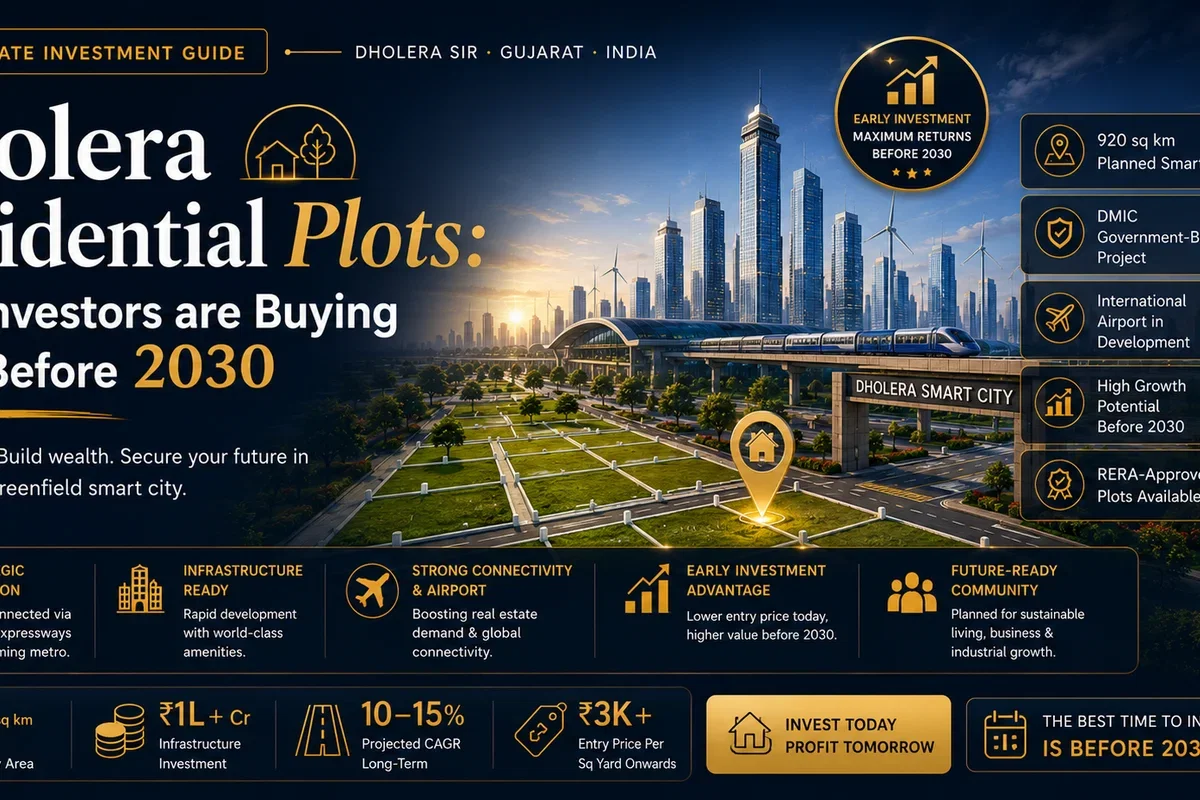
India’s major cities have entered a phase where land ownership has become increasingly out of reach for most new investors. In metros like Mumbai, Delhi NCR, and Bengaluru, entry-level real estate prices have moved far beyond typical household affordability, pushing many investors to look for early-stage opportunities in developing regions.
This shift has revived interest in planned infrastructure-led cities, where land is still available at relatively early valuation stages and long-term growth is tied to government-backed development rather than speculative expansion.
Historically, some of India’s strongest real estate wealth creation stories came from investors who entered early in planned urban corridors such as Gurgaon and Navi Mumbai, before large-scale infrastructure and commercial ecosystems fully developed. These examples continue to influence how investors evaluate emerging cities today.
In this context, Dholera Special Investment Region (SIR) in Gujarat is being closely watched as one of India’s most structured greenfield development projects, supported by national industrial corridor planning and large-scale infrastructure investment, including a ₹91,000 crore semiconductor manufacturing project.
Whether you are an NRI seeking a safe, rupee-denominated asset, a salaried professional planning long-term wealth creation, or a land investor focused on early-stage accumulation, understanding the potential and risks of plots in Dholera is essential.
This guide covers everything you need to make an informed investment decision about residential plots in Dholera with insights from a Trusted Dholera Real Estate Developer. For investors including NRIs, salaried professionals, and long-term land buyers — the key question is not just where to invest, but whether early-stage infrastructure-driven land markets can still offer meaningful entry points in India today.
Key Investment Indicators
Total Dholera SIR Area: 920 sq. km
Semiconductor Investment: ₹91,000 crore
Industrial Ecosystem: 200+ expected units (planned phase-wise development)
Long-Term Development Horizon: 2030–2040
Infrastructure Model: Government-planned greenfield smart city
Why Investors Are Looking at Dholera Amid Limited New-Age Land Opportunities in India
Real estate history is littered with cities that promised transformation but delivered speculation. Dholera is structurally different, and there are four verifiable reasons why. Lower capital requirements than metro cities make it easier to Invest in Dholera Smart City early in the cycle.
India’s large metropolitan regions have already undergone extensive urban development cycles, leaving limited space for new large-scale, government-planned land corridors. As a result, attention is gradually shifting toward structured greenfield projects like Dholera residential plots investment before 2030, where long-term development is still in its early phases.
1. Government Backing - The Rarest Signal in Real Estate
Dholera SIR is not a private township scheme or a developer's marketing narrative. It is a statutory entity created under the Gujarat Special Investment Region Act, 2009, with seed funding of ₹3,000 crore from the central government and co-investment from the Gujarat state government.
The Delhi-Mumbai Industrial Corridor (DMIC) itself is a $100 billion national infrastructure project. When the Indian government literally builds the city from scratch roads, drainage, ICT, power, and water the typical "infrastructure risk" that plagues peripheral investments is substantially mitigated.
2. Industrial Corridor Impact - The Real Estate Multiplier
Sustained real estate growth in emerging cities typically depends on one critical factor — long-term job creation. Without industrial and commercial employment hubs, land appreciation tends to stagnate after initial speculation phases.
History shows a clear pattern: wherever large-scale industrial investment goes, residential real estate follows, as industrial development drives housing demand.
Examples include:
Gurgaon with IT parks, multinational corporations, and MNCs
Pune's Hinjewadi IT corridor, where land prices multiplied after Infosys and Wipro established campuses
Navi Mumbai's planned urban expansion
Dholera is witnessing a similar transformation at an unprecedented scale through:
The semiconductor facility alone is expected to produce over 50,000 wafers per month and generate more than 21,000 direct jobs, creating a powerful job-creation engine that is expected to fuel significant residential demand.
3. Smart Infrastructure - Built for the 21st Century
One of the key risks in early-stage real estate markets is uncertainty around infrastructure completion timelines and execution quality.
Major infrastructure milestones include over 95% completion of Phase 1 infrastructure, including roads, the power grid, drainage systems, the ICT network, and the landmark ABCD Building.
This is not merely planned infrastructure—most of it already exists or is under active development on the ground.
4. Affordable Entry Point
In most established Indian cities, land ownership has already moved beyond the entry stage for new investors, making it difficult to participate in early-value growth cycles.
Despite all of the above, Dholera remains significantly underpriced relative to its fundamentals. Residential plots near the airport and activation area are currently available in the range of ₹9,000–₹14,000 per sq. yard.
Compared with Gurgaon, Navi Mumbai, and GIFT City, Dholera still offers a relatively affordable entry point.
Historical Comparison Perspective:
Gurgaon DLF plots sold at ₹200–₹400/sq. yd in the early 2000s; by 2024, comparable land exceeds ₹80,000/sq. yd.
Navi Mumbai was called "a ghost city" in the 1990s; today its residential plots command ₹30,000–₹60,000/sq. yd.
GIFT City in Gandhinagar followed a similar early-sceptic, late-rush trajectory. A fraction of what comparable infrastructure-adjacent land costs in Gurgaon, Navi Mumbai, or even GIFT City.
This gap will not last. Many investors believe Dholera currently represents a comparable early-stage opportunity.
Why Residential Plots in Dholera Offer Better Long-Term Value Than Flats
In emerging or developing urban markets, investors often face a key structural decision between constructed property and raw land, each carrying different risk-return profiles.
When investors evaluate Dholera, they often compare flats and plots. For a city still in the early-to-mid development phase, residential plots are generally preferred.
1. Lower Entry Cost
Plots can start from approximately ₹8–12 lakh per 100 sq. yards in outer zones, making them more affordable than many apartment options and reducing initial capital outlay and EMI pressure.
2. Flexible Usage
A plot allows you to hold for appreciation, build a home, or sell when market conditions improve, offering full flexibility without being locked into a developer’s design.
3. Higher Appreciation Potential
Land often appreciates faster than constructed property because land supply is finite, and the underlying scarcity factor drives long-term value growth.
4. Minimal Maintenance Cost
Unlike apartments, plots generally avoid society maintenance charges, lift maintenance, structural repairs, and building depreciation, resulting in very low holding costs.
5. Land Banking Advantage
Historically, early-stage smart cities have rewarded investors who accumulated land during the infrastructure development phase, making land banking a key strategy in such markets.
6. NRI-Friendly Asset
Plots are comparatively simple to hold and transfer under FEMA for NRIs, with clear legal documentation, and without tenant management, structural maintenance, or society-related complexities.
Data Point:
In developing cities like Pune's Hinjewadi in 2005–2020, residential plots appreciated at 18–22% CAGR versus 10–13% for apartments in the same corridor.
Early investors in Dholera report 15–20% annual appreciation, with major infrastructure triggers such as the airport, semiconductor plant, and metro not yet fully catalysing pricing.
Best Plot Locations in Dholera: A Complete Micro-Market Guide for Investors
Not all plots in Dholera are equal. Within the 920 sq. km SIR, location drives dramatic price and appreciation differences, and zoning leads to significant variation in value even between nearby plots. Peripheral and unapproved areas carry higher development risk, while proximity to key infrastructure strongly improves appreciation potential. Within planned urban regions, location and zoning often matter more than the broader city narrative itself, especially in early development phases.
Zone-by-Zone Price & Investment Guide (Problem-aware → Solution-aware)
Sr No. | Zone / Location | Price Range (per sq. yd) | Appreciation Outlook | Best For |
1. | Activation Area (TP1 / Zone AB) Near Airport & ABCD Building | ₹11,000 – ₹15,000+ | Very High | Investors seeking fastest appreciation; premium buyers; NRI investors seeking rapid growth potential |
2. | Expressway-Facing Plots Ahmedabad–Dholera 109 km Corridor | ₹9,000 – ₹13,000 | High | Long-term holders; commercial/mixed-use potential |
3. | Dholera International Airport Proximity Zone - within 5 km of Airport | ₹9,000 – ₹14,000 | Very High | Premium residential buyers; retirement planning; NRI investors |
4. | TP2 / TP3 Town Planning Schemes - Government approved layout zones | ₹8,000 – ₹12,000 | Moderate–High | Mid-income investors; families; salaried professionals |
5. | Peripheral Villages (outside core SIR) Bavliyari, Bhadiyad, Hebatpur | ₹5,000 – ₹9,000 | Moderate | Long-term land banking; high risk tolerance; long horizon (10+ years) |
Why location matters within Dholera:
Dholera follows a strict zoning model under SIR regulations. A plot 2 km closer to the activation area can command 30–40% more in current pricing and significantly higher appreciation velocity.
Priorities Premium Residential Plots in Dholera near airport, Dholera activation area, and TP-scheme-approved zones (TP2, TP3) for the optimal risk-return balance. Unapproved plots outside the SIR boundary are cheaper but carry legal and development risk that can erode capital.
Who Should Invest in Dholera? Guide for NRIs, Salaried Professionals, and First-Time Investors
Different types of investors enter early-stage land markets for different reasons, often based on capital availability, risk tolerance, and long-term planning horizons.
Dholera is not a one-size-fits-all investment. Different buyer profiles face different constraints in traditional real estate markets, and the appeal of Dholera lies in how it addresses those gaps through pricing, planning, and government-backed development.
1. Mid-Income Investors
Entering metro cities today requires high capital, while Dholera offers:
Lower capital requirements than metro cities
Strong appreciation potential
Infrastructure-backed growth
2. Salaried Professionals
High property prices make entry difficult in major cities, but Dholera provides:
Lower investment threshold
Long-term wealth creation
Gradual land banking opportunities
3. Business Owners
Traditional markets limit strategic land positioning, whereas Dholera’s industrial ecosystem enables:
Residential investment opportunities
Strategic land acquisition near industrial clusters
Future operational expansion potential
4. NRIs
Global real estate often carries higher entry costs and regulatory uncertainty, while Dholera offers:
Affordable pricing relative to global markets
Government-backed development
FEMA-compliant ownership options
Long-term appreciation potential
5. Families and Retirees
Urban congestion and unplanned development in metros reduce livability, while Dholera provides:
Planned urban environment
Future-ready infrastructure
Opportunity to build a custom home
6. Land Bankers
Early-stage markets eventually close entry windows, which is why many investors focus on Buy Plots in Bulk in Dholera to maximize long-term accumulation benefits.
Expected ROI in Dholera: Property Price Trends, Appreciation Potential, and Future Growth
Looking at the historical plot appreciation in Dholera, there is a clear upward trend in land values over time. Entry-level pricing that was once accessible has significantly increased, reflecting phased infrastructure development and growing demand across zones, especially for those looking to Buy Residential Plots in Dholera.
Historical returns in early-stage infrastructure corridors have varied significantly depending on entry timing, regulatory clarity, and infrastructure execution pace.
Historical Appreciation Overview
Plots priced at ₹1,000–₹1,500 per sq. yard approximately a decade ago have reportedly appreciated to:
₹6,000–₹7,000 per sq. yard in mid-SIR zones
₹11,000–₹15,000+ per sq. yard in premium zones
This represents a 6x–10x increase over roughly a decade, translating to an estimated 10-year CAGR of approximately 18–25%.
Growth ROI Timeline:
2015: ₹1,000–₹1,500 per sq. yard
2025: ₹9,000–₹15,000 per sq. yard
2028: Potential 2x–3x growth from current levels
2035: Potential 3x–5x growth from current levels
Dholera vs Other Asset Classes:
Asset Class | 10-Year CAGR (Estimate) | Liquidity | Inflation Hedge |
Dholera Residential Plots | 18–25% | Moderate | Strong |
Metro City Apartments (Mumbai/Delhi) | 6–10% | Moderate | Moderate |
Gold (Sovereign) | 8–12% | High | Strong |
Nifty 50 (Equity Index) | 11–15% | Very High | Moderate |
GIFT City Commercial | 10–14% | Low | Moderate |
By 2030, projections suggest land values could potentially increase 3x to 5x from current levels.
Note: Projections are based on analyst estimates and historical trends. Past performance does not guarantee future returns. Independent due diligence is recommended.
What Are the Risks of Investing in Dholera? Challenges, Delays, and Due Diligence Tips
Early-stage land markets in India carry a combination of structural, regulatory, and execution risks that investors must evaluate carefully before making long-term commitments.
These risks are often not visible at the time of purchase but can significantly impact liquidity, resale value, and overall investment outcomes.
Any credible investment guide for Dholera SIR must address the downside, including structural risks, execution timelines, and legal verification requirements. These factors determine whether an investment is sound or speculative.
Risk Factors & Due Diligence
1. Speculative Pricing in Some Projects
Not all plots marketed as "Dholera plots" are within the SIR boundary. Some peripheral schemes use proximity to Dholera as a selling point while offering plots outside the approved planning framework. Avoid unregistered schemes offering cheap plots without clear land titles. Speculative marketing, unclear land titles, and unapproved layouts are among the most common issues faced by investors in emerging real estate corridors.
2. Infrastructure Delay Risk
Large-scale government projects may experience timeline changes. While delays may not necessarily impact long-term land value trends, they can affect short-term liquidity and resale momentum.
3. Long Gestation Period
Dholera is a long-term investment, not a quick-flip asset. If liquidity is required within 2–3 years, this may not be suitable. Full infrastructure catalysation — including airport operations, metro connectivity, and industrial commissioning — is expected to unfold over a 5–10+ year horizon.
Legal Due Diligence Is Non-Negotiable
Independent verification is strongly recommended before purchase. Ensure the following:
NA-NOC (Non-Agricultural Land Certificate) is in place
Clear land title with 7/12 extract from the revenue department
Plot falls within an approved TP Scheme (TP1, TP2, TP3)
RERA registration is verified (where applicable) for project and developer
Government-approved layout plans from the relevant planning authority
Encumbrance-free status with no disputes or litigation
Independent verification by a local property lawyer
Avoid any unregistered schemes offering "cheap plots" without clear documentation
How to Choose the Right Residential Plot in Dholera: A Step-by-Step Buyer's Guide
Choosing a plot in Dholera SIR requires careful evaluation of location, developer credibility, infrastructure access, and exit potential, especially when exploring Smart City Plots for Sale in early-stage zones. In early-stage land markets, investment outcomes are often determined more by selection discipline than by broad market performance.
1. Infrastructure Proximity:
A plot located closer to the airport zone, expressway junction, or industrial clusters can command significantly higher future resale value. Proximity to planned transport links and infrastructure hubs should be prioritized over short-term price differences.
2. Location within the SIR:
Prioritize activation area, airport-zone plots, and TP-approved schemes for stronger appreciation potential. TP2 and TP3 zones provide a balance of affordability and 7–10 year upside, while peripheral plots outside the core SIR require higher risk tolerance and longer holding periods.
3. Developer Credibility:
Select only developers with a proven track record in Dholera projects, transparent documentation practices, and successful delivery of previous phases. Projects must be supported by verified legal documentation and established execution history.
4. Resale Potential:
Plots within TP-scheme zones with developed internal roads and utility access generally attract a wider resale market. Exit potential should be considered at the time of purchase, not only entry pricing.
Red Flags to Avoid
Missing land title documents, including 7/12 extract or NA-NOC
Projects marketed as “Dholera plots” priced significantly below zone benchmarks, often outside the SIR boundary
High-pressure sales tactics such as urgent booking incentives or artificial scarcity claims
Unregistered schemes without proper regulatory approvals or RERA registration
Always verify all documentation independently before committing capital
Why NRIs Are Increasingly Investing in Residential Plots in Dholera
For many non-resident investors, access to large-scale land assets in global metropolitan regions is often limited due to high entry costs and regulatory barriers.
Gujarat has consistently been among the top states attracting NRI real estate investment in India, supported by trusted advisory networks such as AUM Antarim, which focus on structured land investment opportunities. Dholera adds a specific NRI investment case that goes beyond regional familiarity.
For NRIs earning in USD, GBP, or AED, global property markets often present high entry costs and limited accessibility, whereas Dholera’s current pricing remains highly affordable. A 200 sq. yard premium plot near the airport zone at ₹12,000/sq. yd translates to roughly $29,000 USD at current exchange rates — the equivalent of a modest car purchase in the United States. This creates an entry point into a government-planned city with long-term appreciation potential.
Dholera offers:
Affordable entry compared to global property markets
Government-backed planning
Long-term appreciation potential
FEMA-compliant ownership structures
Future retirement and relocation possibilities
The India growth story driven by demographic tailwinds, Make in India policy, and technology manufacturing ambitions such as semiconductor projects further strengthens the long-term outlook for Indian real estate. For many NRIs, this also creates the option to secure land today at pre-development prices and build a future residence upon relocation, locking in both land cost and future housing plans simultaneously.
From a regulatory standpoint, NRIs can purchase plots in Dholera under FEMA regulations, subject to standard repatriation rules. Investing through RERA-registered and NA-NOC-approved projects ensures legal compliance and repatriation-friendly documentation.
Future of Dholera Smart City: Development Roadmap, Infrastructure Growth, and Outlook for 2030–2040
Large-scale planned cities typically evolve in phases over multiple decades, and early-stage infrastructure periods often involve uneven development progress.
The long-term vision of Dholera SIR is built around a fully planned smart city ecosystem designed to address the limitations of retrofitted urban growth, such as congestion, fragmented infrastructure, and unbalanced development.
Instead of unplanned expansion, the city is structured around integrated infrastructure, including international airport connectivity, semiconductor manufacturing ecosystems, metro rail integration, green energy infrastructure, smart city technology, and planned residential communities.
Imagine arriving at Dholera International Airport not from Ahmedabad, but directly from Singapore, Dubai, or Frankfurt. You board the metro to the city centre, passing orderly industrial zones where chip fabs, green energy facilities, and advanced manufacturing plants operate alongside tree-lined residential sectors.
Your smart home is connected to the city's IoT grid. Power is 24/7, sourced from large-scale solar infrastructure. The roads are uncongested because they were designed from scratch for future population growth rather than retrofitted for existing demand.
Expected Development Milestones of Dholera
Milestone | Timeline | Impact on Real Estate |
Dholera International Airport | 2025–26 | Immediate price catalyst in airport zone |
Tata Semiconductor Fab Production | 2026 | 21,000+ jobs; residential demand surge |
Ahmedabad–Dholera Metro Rail | 2027–28 | Commuter belt expansion; residential growth |
200+ Industries Operational | 2027–29 | Self-sustaining economic ecosystem |
Full Phase 1 Residential Occupation | 2028–30 | Resale market matures; prices stabilise at higher levels |
Phase 2 & 3 Expansion | 2030–40 | Second wave of appreciation for early landowners |
The Dholera Smart city spans ( 929 sq. km) which is larger than Singapore’s (700 sq. km) and is planned with multiple zones dedicated to non-polluting industries alongside integrated urban infrastructure. Many analysts expect continued growth as infrastructure and employment opportunities mature, with full realization of the master plan projected over 2030–2040.
FAQ About Dholera SIR Investment Opportunities
1. Is Dholera a safe investment in 2025?
Safety depends on legal verification. Plots within approved Town Planning (TP) Schemes with clear title, NA-NOC, and proper documentation are generally considered lower risk. Unregistered projects or plots outside the SIR boundary carry higher risk. The main concern is the development timeline, not capital safety for verified land.
2. What is a TP Scheme and why is it important?
A Town Planning (TP) Scheme is a government-approved land development framework that defines roads, utilities, zoning, and land use. Buying within a TP Scheme ensures structured development, legal clarity, and better infrastructure access.
3. What is the minimum investment required?
Entry-level residential plots typically start around ₹8–12 lakh for 100 sq. yards in outer zones. Premium zones such as airport and activation areas are priced higher depending on location and infrastructure proximity.
4. Can NRIs buy plots in Dholera?
Yes. Under FEMA regulations, NRIs can invest in residential plots and buy commercial plots in Dholera. To ensure legal protection for the investment and eligibility for repatriation of funds, compliance with RERA regulations, clear title requirements, and NA-NOC approvals is mandatory.
5. Is Dholera better than GIFT City for investment?
They serve different purposes. GIFT City is a financial and commercial hub, while Dholera focuses on large-scale residential and industrial development. For land-based residential investment, Dholera offers lower entry costs and higher long-term growth potential.
6. What is the expected ROI?
Historical trends show strong appreciation in select zones. Some projections estimate 2x–3x growth by 2028 and 3x–5x by 2030 in premium locations. Actual returns depend on location, legal status, and infrastructure development.
7. When will Dholera be fully developed?
Development is phased. Key milestones include airport operations (2025–26), semiconductor production (2026), metro connectivity (2027–28), and large-scale industrial occupancy (2027–30). Full maturity is expected between 2030 and 2040.
Ready to Invest in Dholera?
Explore verified plots in Dholera SIR and conduct thorough due diligence before making any investment decision.
Dholera is not about quick gains-it is about strategic positioning in one of India's most ambitious urban development projects.
Conclusion
Dholera represents a long-term infrastructure-led land development opportunity, where outcomes are heavily dependent on timing, location selection, and execution of planned infrastructure projects.
Opportunities like this exist primarily in early phases, Aum Realties help investors evaluate structured entry points in emerging markets. The fundamentals are already in place: government-backed infrastructure, a ₹91,000 crore semiconductor investment, a live international airport, 200+ industries planned, and large-scale development signals similar to past growth corridors such as Gurgaon and Navi Mumbai, which rewarded early entrants who acted before mainstream demand arrived.
In early-stage land markets, both timing and selection matter significantly, and investment decisions should be made after careful evaluation of legal clarity, infrastructure progress, and long-term holding capacity.
“The biggest mistake in real estate isn't choosing the wrong property - it's waiting too long to choose the right one.”